Event 1
Murder of George Glenn
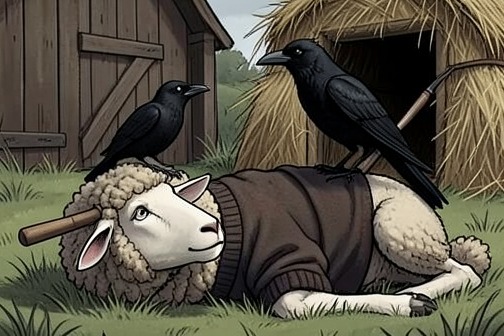
[George Glenn](entity:character-recall-character-george-glenn-db173571c431)’s death becomes the starting point for his flock’s investigation and a test of what the sheep mean by justice. Found beside the [hay barn](entity:location-recall-location-hay-barn-4478115ff603) with a spade wound, [George](entity:character-recall-character-george-4ccc9776b2d0) is initially treated as the victim of a human crime; a hoofprint and later revelations complicate that account, linking the apparent murder to both village suspicions and a private history of estrangement.
## Discovery and the Flock’s Decision
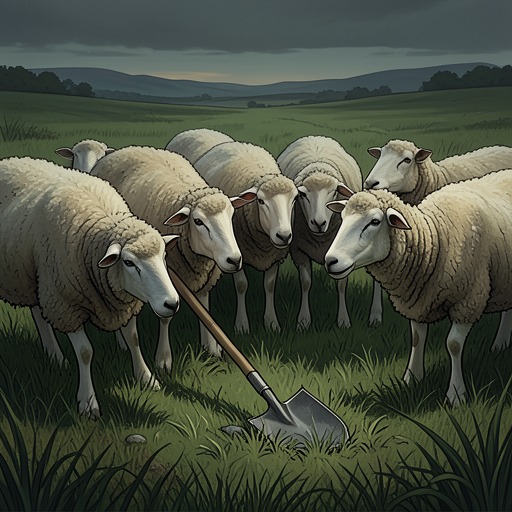
George lies in the grass near the path through the fields, close to the hay barn. A crow perches on his sweater while a rabbit sits nearby; at a distance, the sheep hold a meeting. They are proud that they have kept calm, though their first alarm is practical: without a shepherd, who will bring them hay? [Miss Maple](entity:character-recall-character-miss-maple-a9c5dcdeac95) quiets them by pointing out that the rich pasture makes hay unnecessary in midsummer, and that a wolf would not use a spade. The tool in George’s body makes the death appear to be a human act.
[Sir Ritchfield](entity:character-recall-character-sir-ritchfield-b2c8606df44b) dismisses illness as an explanation, and [Othello](entity:character-recall-character-othello-45ef6b29852c) argues that the attacker must have been human, or an unusually large monkey. Maple turns that deduction into an obligation. George had sought out the culprit when a fierce dog took one of the lambs; as their shepherd, he deserved the same effort from them. The flock adopts Othello’s call for justice and resolves to solve the killing themselves.
Maple examines George while the others wait together at a distance. She circles before approaching, inspects the spade, and smells his clothes and face. She also notices details that do not fit easily into a simple account: his face seems peaceful, his clothes smell of smoke, and he holds flowers, although he is usually more interested in vegetables. Most importantly, she finds a single sheep’s hoofprint on his pale stomach, slightly above the wound. The mark becomes a concrete clue, but the evidence does not identify whose hoof made it or establish what happened.
## Clues at the Pasture
The day after [George’s death](entity:action-recall-action-4384f06c6fc4), the flock ventures out from the barn into a world without either shepherd or sheepdog. [Mopple the Whale](entity:character-recall-character-mopple-the-whale-c8870eb308f4) leads the hungry sheep toward the vegetable garden behind George’s caravan. George had fenced the garden off, but with him gone, [Lane](entity:character-recall-character-lane-aadcfcb57a55) nudges back the bolt and the flock eats the lettuces, peas, radishes, cress, tomatoes, endives, buttercups, and chives. Their brief raid ends in silence and shame.
The garden episode also draws attention to a tool associated with George’s work there. The spade that usually leaned against the back of the caravan is absent. The discovery does not by itself solve the killing, but it gives the flock a specific absence to set beside the spade found with George and the hoofprint Maple has noticed. Ordinary pasture details become evidence because the sheep are trying to reconstruct a human event with the knowledge available to them.
## Village Suspicions and Material Stakes
The death is also interpreted through the interests of the village. Harry argues that something hidden at George’s property must be drugs, and warns that discovery would ruin plans for a dolmen attraction, pony rides, a cultural centre, whiskey sales, and a seaside hotel. Tom backs a different part of the accusation: George had obstructed tourism, kept people away, and frightened them off, while boats supposedly brought goods to the beach at night for transport in his old vehicle the next day. These are villagers’ claims, not proof of George’s role or of a motive for his death.
Their accusations place the pasture inside a conflict over land and profit. To the sheep, the meadow is a place to graze and the garden is the food George had kept from them; to the villagers, the same property represents a potential business. The competing accounts deepen the mystery without confirming who killed George. They also show why the sheep’s investigation cannot be separated from the struggle over what his land is for.
## [Rebecca](entity:character-recall-character-rebecca-a2bff63b7d1a)’s Story and the Retrospective Reframing
Later, Rebecca tells the sheep a story about a little girl with two fathers: one acknowledged and one secret. The girl and her secret father love one another, but after a quarrel they stop speaking. When he writes that he plans to travel to [Europe](entity:location-recall-location-europe-90be8cc79c46) and wants to see her first, she hides her happiness and keeps him waiting. He dies before they meet. Rebecca’s story gives the death an intimate context the flock’s early search for a culprit could not provide: George had a secret daughter, and their estrangement left a final meeting unrealized.
The story does not name a killer or explain the hoofprint, and it is not a formal resolution of the flock’s case. Instead, it changes the emotional shape of George’s death. The apparent crime remains entangled with unanswered questions, but the account of a father who waited for his daughter makes absence and delayed reconciliation central to how his end is understood. The flock begins with a demand for justice; Rebecca’s tale reveals a loss that cannot be reduced to identifying an assailant.
Event 2
Glennkill flock’s investigation into George’s killing
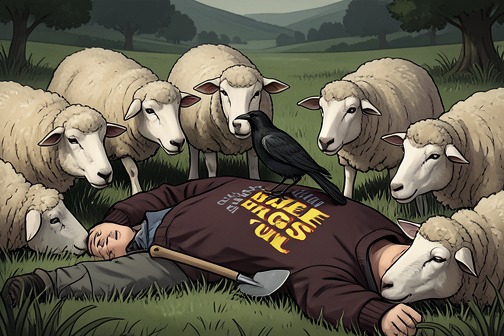
[Glennkill flock’s investigation into George’s killing](entity:event-recall-event-5c48f4ae46e8) begins when the sheep refuse to treat their shepherd’s death as a human matter beyond their concern. Led by [Miss Maple](entity:character-recall-character-miss-maple-a9c5dcdeac95), they make a collective promise to identify the person who killed [George Glenn](entity:character-recall-character-george-glenn-db173571c431). The inquiry becomes more than a search for a culprit: it forces the flock to confront the human world surrounding its pasture, and to decide whether understanding a disturbing story is worth the fear it brings.
## The discovery and decision to investigate
[George](entity:character-recall-character-george-4ccc9776b2d0)’s body lies in the grass beside the [hay barn](entity:location-recall-location-hay-barn-4478115ff603), a crow perched on his woolly sweater and a spade protruding from him. The sheep had initially feared practical consequences—who would bring them hay?—but Miss Maple has already reasoned that neither midsummer hunger nor a wolf explains the scene. [Sir Ritchfield](entity:character-recall-character-sir-ritchfield-b2c8606df44b) is equally blunt: George did not die of an illness, because a spade is not an illness. The physical fact of the weapon turns a baffling absence into a crime.
Miss Maple argues that George had once looked for whoever was responsible when a fierce dog took one of their lambs. Because he was their shepherd, the flock owes him the same effort. She calls the act wolfish and identifies it as murder. [Othello](entity:character-recall-character-othello-45ef6b29852c) sharpens the question of who could have done it: in his view, the culprit must be human, or an exceptionally large monkey. His reference to his youth at [Dublin Zoo](entity:organization-recall-organization-dublin-zoo-4d8ff8f9c329) supplies the experience behind the unusual comparison, but does not solve the case.
When [Heather](entity:character-recall-character-heather-c102c98231de) asks what should happen after they find the person responsible, Othello answers with the demand for justice. The other sheep take up the word, and [George’s flock](entity:organization-recall-organization-george-s-flock-e57e05f7ecfd) resolves to investigate for itself. Their decision is grounded in reciprocal care: George had protected them, and they will not allow the spade in his body to become an event nobody tries to explain.
## Following clues through a human landscape
The first inquiry is physical and uncomfortable. Miss Maple circles George at a distance, approaches the spade, sniffs his clothes and face, and finally puts her nose into the wound. The other sheep watch from a huddle, holding their breath; she returns with blood on her muzzle. The investigation is therefore conducted not from a safe human vantage but through the flock’s own senses and the body it is trying to understand.
Everyday places and objects acquire possible evidentiary weight. Behind the hay barn, George’s caravan stands beside his fenced vegetable garden, where he had grown lettuces, peas, radishes, cress, tomatoes, endives, buttercups, and chives. After [George’s death](entity:action-recall-action-4384f06c6fc4) the sheep push open the garden gate and strip the beds. The raid ends in shame, but Othello, who did not join in, draws Miss Maple’s attention to the place where George’s gardening spade usually leaned. It is missing. The episode gives the absent tool a specific history and location: the flock knows it as an ordinary implement associated with the garden, even as a spade at the crime scene signifies violence.
The human community offers a more compromising explanation of George’s life. [Harry the Sinner](entity:character-recall-character-harry-the-sinner-6da24bf545ce) dismisses the possibility that there is no contraband in the caravan and argues that George’s small flock could not have supported him. [Tom O’Malley](entity:character-recall-character-tom-o-malley-34b5322bdb58) adds an account of boats arriving on the beach at night, goods being taken to the caravan, and George driving away the next day. Their talk also recalls his hostility to tourists and developers: he had thrown sheep droppings at visitors, refused access, and fired a pistol to frighten people away. These are claims made by villagers, not a verdict established by the inquiry; they nevertheless change the apparent setting from an untouched pasture into land caught between George’s secrecy and others’ commercial ambitions.
## Doubt, fear, and the urge to stop
As the questions accumulate, the investigation begins to divide the flock. Miss Maple names unresolved matters that the sheep themselves have raised: [Tess](entity:character-recall-character-tess-7136fe16a68b)’s whereabouts, the wolf’s ghost, what [God](entity:character-recall-character-god-28f937b98b12) was seeking in the meadow, the connection between [Lilly](entity:character-recall-character-lilly-7ce8fed14a16) and [Kate](entity:character-recall-character-kate-ba739b4bb276), [Ham](entity:character-recall-character-ham-d7883aa636d4)’s presence, George’s relation to drugs, and the identity and purpose of a master hunter. She treats the questions as reasons to continue. [Maude](entity:character-recall-character-maude-a64555802aa1), by contrast, says the main thing is that the hunter not return; she trusts her nose to recognize him if he does. The difference is not simply between cleverness and ignorance, but between the need to know and the wish to feel safe.
Miss Maple answers the flock’s calls to stop thinking by invoking George’s story about the wolf in sheep’s clothing. Her warning is that danger cannot be dismissed merely because its explanation is frightening or unclear: either the flock finds the wolf, or the wolf finds them. She insists that a story must be followed to its end. [Cloud](entity:character-recall-character-cloud-18ae32e774f3)’s quiet reply—that the flock needs a shepherd—makes the cost of Maple’s determination visible. George had supplied direction; without him, the flock must choose whether to follow its own investigator.
That tension recurs when [Gabriel](entity:character-recall-character-gabriel-bc97a48fb87d) uses George’s scythe to cut grass. The sheep watch a human grazing: the blade passes through the meadow, leaving flattened grass behind, while Gabriel gathers it for his flock. To the sheep, the act looks like senseless destruction, even though it is grass they would ordinarily eat. The scene does not identify George’s killer, but it alters the flock’s reading of human actions and of tools. An implement associated with ordinary work can become frightening in another hand, just as the spade’s familiar place in George’s garden cannot explain how it came to be in his body.
## What the inquiry brings into view
The investigation also draws out a concealed family history. One night, [Rebecca](entity:character-recall-character-rebecca-a2bff63b7d1a) reads to the sheep and then abandons her book for a tale about a girl with two fathers, one secret and one acknowledged. The secret father and daughter were fond of each other, but a quarrel kept them apart; when he wrote that he planned to travel to [Europe](entity:location-recall-location-europe-90be8cc79c46) and wanted to see her first, she concealed her joy and made him wait. He waited until he died. Presented as a story rather than a direct confession, the account nevertheless discloses Rebecca’s history with George and gives their estrangement a painful shape: he sought a meeting, and she did not answer him in time.
The flock’s inquiry thus links the immediate mystery of the missing or misused spade to larger uncertainties about George’s private life, the land, and the people who move through it. It exposes allegations of smuggling without proving them, and a family disclosure without converting it into a solution to the murder. Its clearest outcome in these episodes is a changed understanding of what the sheep have undertaken. They began by promising justice to their dead shepherd; following the questions reveals that the story they must face includes not only who killed George, but what their human relationships and apparently familiar pasture had concealed.
Event 3
Melmoth’s disappearance from the flock
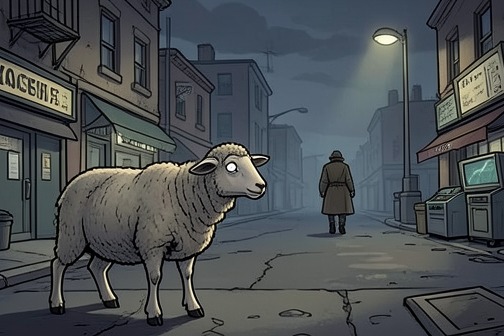
[Melmoth’s disappearance from the flock](entity:event-recall-event-a462eb6fc87e) is a defining warning in the sheep’s shared memory: the legendary ram leaves, and the story of his absence binds fear of separation to the rule that no sheep may leave the flock. [Sir Ritchfield](entity:character-recall-character-sir-ritchfield-b2c8606df44b), [Melmoth](entity:character-recall-character-melmoth-40a40f9a8507)’s twin brother, supplies the most concrete account, but the episode reaches the reader through recollection and rumor rather than a witnessed scene. His certainty that Melmoth died sits beside the story’s unresolved absence of a body or an independently confirmed cause.
## Identity and the Story of Leaving
Melmoth is introduced as Sir Ritchfield’s twin and as a legendary ram who disappeared. His fame is inseparable from the fact that he went away: the flock remembers no ordinary departure, but a frightening exception to the rule that sheep belong together. The story has become so charged that the sheep know it even while avoiding it. Mother ewes whisper it to their lambs as a warning, and the account is described as an impossible story without any kind of haystack in it. Its place in flock lore is therefore not just as a record of one ram’s fate; it is a lesson passed between generations, made more powerful by the flock’s reluctance to tell it aloud.
## Sir Ritchfield’s Recollection
The clearest account comes when [Cloud](entity:character-recall-character-cloud-18ae32e774f3) says that Melmoth went away. [Heather](entity:character-recall-character-heather-c102c98231de) loses her balance and falls sideways; the other sheep look away. Their reactions show how abruptly the name breaks the quiet and how thoroughly the flock has learned to fear the tale. Sir Ritchfield overhears them despite their speaking very quietly. He answers twice that Melmoth is dead, turning a departure that the others can only name indirectly into a blunt declaration.
Ritchfield’s explanation is specific but limited. [George Glenn](entity:character-recall-character-george-glenn-db173571c431) went looking for Melmoth with [Butcher’s dogs](entity:creature-recall-creature-butcher-s-dogs-cec2e469019f), then came back smelling of death. On the fifth night, Ritchfield says, he alone waited by the shepherd’s caravan for [George](entity:character-recall-character-george-4ccc9776b2d0) and smelled death there too. That image of solitary waiting gives the disappearance its bleakest detail: the twin remains behind, keeping watch through a night marked in memory, while the returning shepherd brings back a smell Ritchfield associates with death. The account establishes a search and a return, but does not describe what George found, where Melmoth went, or how he died. Ritchfield’s certainty is part of the flock’s understanding; it does not supply independent proof of the missing ram’s fate.
## A Warning That Governs the Flock
Ritchfield attaches the story directly to a prohibition: no sheep may leave the flock. After his declaration, none of the sheep dares answer. Their heads sink one by one, and they begin grazing automatically. The movement back to routine does not resolve their questions; it shows how fear turns a troubling story into obedience. They wonder whether a scentless robber is stealing the fattest, strongest, and cleverest sheep, and imagine the wolf’s ghost or other threatening figures. [Melmoth’s disappearance](entity:action-recall-action-c8bebbd5264e) thus continues to shape what the flock fears even when no new explanation is available.
The story also resurfaces as a comparison between generations. When Mopple breaks away and moves toward the herbs at George’s Place, Ritchfield bars his way and remarks that the young must sometimes be made to respect their elders or they will end up like Melmoth. [Miss Maple](entity:character-recall-character-miss-maple-a9c5dcdeac95) considers the comparison misplaced: Mopple is unlike Melmoth. Her disagreement exposes how the warning can be used to discipline a younger sheep even when the resemblance does not hold. Melmoth’s name functions as a cautionary example, but its force comes from the flock’s fear, not from a settled account of what happened.
## Mystery and Narrative Significance
The novel presents the disappearance in fragments: first as a story known but avoided, then as Cloud’s brief admission, and finally through Ritchfield’s recollection of George’s search and the fifth night. That delayed disclosure makes the event feel less like a completed history than a wound in the flock’s memory. The repeated smell of death links Melmoth’s absence to George’s return, while leaving the essential circumstances unstated. In a pastoral world organized around grazing, shepherding, and the flock’s rules, Melmoth’s departure is the exception that makes those rules frighteningly absolute. His fate remains unverified, but his disappearance continues to govern how the sheep understand separation, danger, and belonging.
Event 4
Othello’s rescue by George and escape from the dogfighting ring
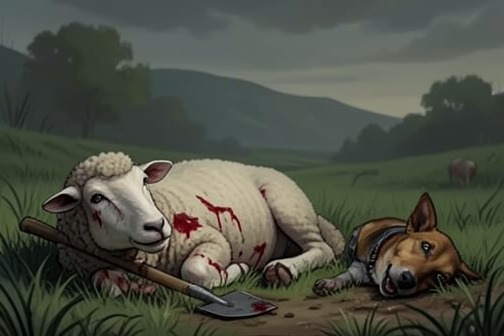
[Othello](entity:character-recall-character-othello-45ef6b29852c)’s rescue by [George Glenn](entity:character-recall-character-george-glenn-db173571c431) is a defining encounter in the ram’s life: [George](entity:character-recall-character-george-4ccc9776b2d0) finds him bloodied after a fight with dogs and takes him away, beginning a bond rooted in attention and survival. Remembered at George’s funeral, the scene also gives the promise of [Europe](entity:location-recall-location-europe-90be8cc79c46) a lasting weight: George never makes the journey with Othello, but his will later provides for the flock to go there.
## The Rescue Remembered
At George’s funeral, Othello recognizes who is inside the coffin by scent. While others attend to the ceremony, he remembers first seeing George through cigarette smoke, with blood running into his eyes and his legs trembling from exhaustion. The dog beside him is dead, but Othello expects another dog to come; survival has not yet meant safety. He wants to close his eyes, but an admonition that closed eyes mean death makes him force them open.
George meets his gaze with such interest that Othello can hold on until his legs stop trembling. The encounter is presented through Othello’s memory, not as a detached account of a rescue. Its decisive action is initially an act of looking: George’s attention gives the injured ram something to focus on when his body is failing.
## From the Fighting Ground to the Car
Othello turns toward the doorway through which the dogs came and lowers his horns. The gesture makes clear that, even exhausted and wounded, he remains ready to face what may come through it. George then takes him away. Soon Othello is lying across the back seat of George’s old car, bleeding, while George sits at the wheel in the dark.
A separate recollection of Othello’s arrival in the flock fills in the visible aftermath: he appears one morning as a full-grown ram with four dangerously curved horns and a striking wound across his forehead. George tends the wound with the stinging ointment the sheep fear. He sings, whistles, dances, and is so excited that he takes off his woolly sweater. Othello, by contrast, stands perfectly still. The sheep do not see him arrive at the pasture, but George’s unusual joy and careful treatment make the rescue’s effects immediately apparent to them.
## The Promise of Europe
In the car, George announces, “We’re going to Europe.” The promise gives their escape a destination, but Othello later recognizes that George was wrong: they never went. The distance between the declaration and its fulfillment is not erased by the rescue. Othello remembers the failed promise alongside the act that saved him, and his thought of justice carries both the rescue’s significance and its incompletion.
After [George’s death](entity:action-recall-action-4384f06c6fc4), the promise returns in a concrete form. His will leaves the rest of his fortune to his sheep so they can go to Europe as he promised. The money is to be administered for them, and they must have an authorized representative to accompany them as shepherd. The document also sets out care conditions, including daily reading aloud, and requires an outside check on the representative’s duties. The flock’s journey is therefore no longer simply the plan George voiced in the car: it becomes a legal provision whose realization depends on choosing someone to represent them.
## A Bond Seen Through Othello
The memory explains why Othello’s response to George’s death differs from that of the people at the funeral. He behaves solemnly among the gravestones, recognizes George in the coffin by scent, and remembers the first encounter that brought them together. His connection to George is conveyed through precise acts and sensations—the held gaze, the wound, the car, and the remembered promise—rather than through a stated account of affection.
The rescue also makes Othello’s later sense of justice personal. He was taken from a scene in which another dog could always replace the one who had died; George’s attention offered a way out, but the promised journey remained unfinished. When the flock’s future is subsequently secured through the will, the old promise gains a new possibility without changing the fact that George and Othello never traveled to Europe together.
Event 5
Othello drives off the wolfhound
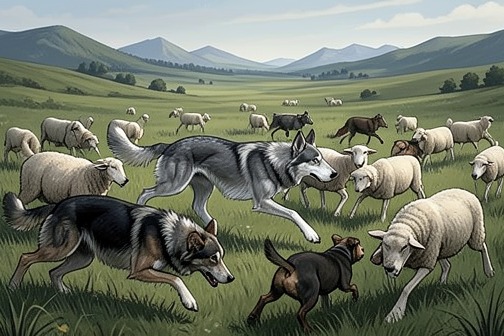
[Othello](entity:character-recall-character-othello-45ef6b29852c) drives off a gray wolfhound that turns a familiar threat—the dogs’ herding—into a hunt. As the human gathering near the dolmen draws the dogs farther across the meadow, the flock breaks apart in panic; Othello alone meets the wolfhound’s charge. [Zora](entity:character-recall-character-zora-86e14b4c614c) witnesses a reversal of the expected order: the sheep is faster, more composed, and finally more dangerous than the dog that seemed certain to prey on him.
## The [Dogs](entity:creature-recall-creature-dogs-e0736038fb3e) Advance
The danger grows as the human groups move closer to the dolmen. A couple of dogs had previously explored the meadow near their masters, sniffing about and being whistled back or ordered to lie down. Now three sheepdogs and another dog have formed a pack. The sheepdogs move low across the meadow, their dappled coats glinting as they head toward the hill. The flock recognizes the old discomfort of being driven apart and brought together again, but the gray wolfhound changes the meaning of the approach: it does not bark or hesitate, and its movement looks less like herding than hunting.
The flock’s alarm becomes panic. [Sheep](entity:creature-recall-creature-sheep-fc2e92cc9afd) dash in every direction, carrying the startled sheepdogs with them. Mopple runs through the human crowd and knocks [Harry the Sinner](entity:character-recall-character-harry-the-sinner-6da24bf545ce) over, while Zora takes refuge on her rocky ledge. From there, she is the only sheep able to see clearly what happens on the hill near [George](entity:character-recall-character-george-4ccc9776b2d0)’s Place. The flock’s confusion is not merely a reaction to an unfamiliar dog; it leaves Othello’s encounter with the wolfhound almost entirely unwitnessed.
## Othello Turns on the Wolfhound
At the foot of the hill, Othello and the wolfhound are both rising from the ground. Othello attacks first, although, from Zora’s perspective, he should have fled. The wolfhound initially fails to recognize the black figure racing toward it as prey. When it does, it charges, but loses its nerve before the two collide, braking and swerving aside. Othello changes direction in a slight curve and gallops back toward it.
That repeated advance exposes the difference between the two opponents. Othello is faster, and the wolfhound seems to realize it; still, it crouches with its teeth bared, ready to leap at the ram from below. The encounter is not described as a prolonged struggle with a clear view of each blow. Zora sees the approach and the shifting balance, then closes her eyes, trying to turn her attention away from the danger. The next decisive sight is a dark body on the ground, its feet twitching as if still trying to run. For a moment she believes the wolfhound has brought Othello down. She then sees that the fallen animal is the wolfhound, while Othello is nowhere in sight.
## The Wolfhound Is Carried Away
The wolfhound cannot get back to its feet. Its young master, one of the men who had laughed unpleasantly, approaches and prods it with his foot. A farmer then lifts the injured dog and carries it away. Blood on its belly alarms the people around the meadow. They cannot explain what has happened to an animal they regarded as strong, and cries of Satan and Goblin King pass through the crowd. The human gathering retreats in haste; [George’s spade](entity:object-recall-object-george-s-spade-6776dda11635) is left behind.
The outcome is strikingly different from the flock’s first interpretation of the attack. Sheep that had expected to be chased and driven apart have seen one of their own confront the dog rather than flee. Yet the flock does not gather around Othello or publicly acknowledge what he has done. Zora sees him again among the sheep as they slowly settle and begin grazing, but no one appears to take particular notice of him. His return confirms that he survived the encounter; the flock’s subdued response leaves the action without any explicit recognition or explanation from the other sheep.
## Zora’s Witness and the Reversal of Predation
Zora’s position on the rocky ledge shapes how the scene is told. She can watch the attack from a distance, but she cannot bear to keep looking when the wolfhound crouches to spring. To steady herself, she recalls the birth of her first lamb, brown as earth, and the resolve she felt to defend him against the world. That memory does not explain Othello’s choice, but it sets the danger against a ewe’s intimate knowledge of vulnerability and protection. Her attention then returns to the hill, where the apparent victim is not the sheep but the dog.
The fight overturns the flock’s assumption that no sheep can stand against the force of dogs. The ordinary sheepdogs have approached as instruments of human control, driving animals that have been herded many times before; the wolfhound makes that familiar pressure suddenly lethal. Othello’s speed and repeated charges interrupt the expected chase, and the crowd’s retreat follows the reversal. The scene gives Zora evidence of Othello’s capacity for violence and leaves her thinking how little she knows about him. It also presents the pasture not as a quiet refuge from human activity, but as a contested place where animals can be hunted, driven, and, unexpectedly, fight back.
Event 6
Ham’s fall from the cliffs in the fog
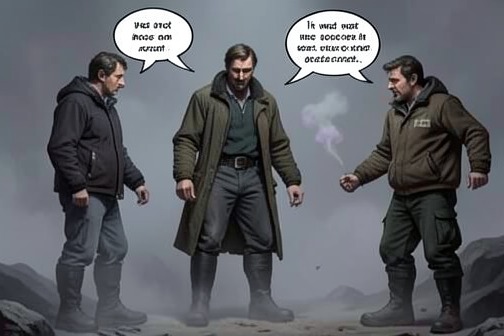
[Ham](entity:character-recall-character-ham-d7883aa636d4)’s fall from the cliffs is a turning point whose cause remains uncertain but whose apparent accident is openly challenged. The book first places the reader in a fog-bound landscape of danger, then lets two men’s conversation disclose that Ham may have been lured to the cliffs by a scented note. He survives the fall, but the doctors do not expect him to walk again. The event therefore changes his physical future while opening a question the available account does not resolve: who summoned him, and what did Ham remember?
## Circumstances and Suspicion
The fall is discussed after the fact rather than shown directly. One of the men asks whether Ham’s injury was really an accident; the other answers with certainty that it was not. His reasoning begins with Ham’s reputation for sure-footedness and the apparent improbability of his being on the cliffs at all. He proposes that someone lured him there, using a note carrying the scent of violet perfume. The detail turns a seemingly simple fall into a possible act of deception, while identifying neither the sender nor the reason for the trap.
The conversation gives no account of the precise moment Ham went over the edge: there is no description of his route, the weather at the instant of the fall, or what happened immediately afterward. Its emphasis is instead on how the accident story fails to satisfy the men discussing it. Their suspicion is specific enough to suggest a deliberate summons, but it remains an accusation rather than a solved explanation. The note and its perfume become clues to an unseen approach, not proof of who arranged the meeting.
## The Fog-Bound Cliff Sequence
The book also places Mopple in a dense mist near the cliffs, where the landscape itself becomes difficult to read. After emerging from the [hay barn](entity:location-recall-location-hay-barn-4478115ff603), he finds the fallen spade that [Tom O’Malley](entity:character-recall-character-tom-o-malley-34b5322bdb58) had left on the meadow. It carries only a faint trace of human scent, which Mopple slowly distinguishes as soapy water, whiskey, cleaning fluid, a short rancid beard, and unwashed feet. Before he can make sense of the figure moving sideways through the mist, he loses his nerve and runs.
Mopple collides with the butcher, who repeatedly falls in the mud while trying to seize him. When the butcher clenches his hands together, Mopple is too exhausted and frightened to move; then the man abruptly disappears. As the mist briefly parts, Mopple realizes that he is standing at the edge of the abyss and retreats. This episode supplies a vivid, bodily image of danger in the fog and at the cliff edge, but it does not establish that the butcher caused Ham’s fall or that Mopple witnessed Ham going over. The separate account of Ham’s injury comes through the later conversation, which names the possible lure but leaves the fall itself offstage.
## Injury and Prognosis
The men confirm that Ham is alive. The doctors consider his chances not so bad, yet they expect that he will never walk again. That distinction gives the fall its stark consequence: Ham has survived, but the prognosis describes a lasting loss of mobility. The conversation does not give a fuller medical account or establish whether his condition later changes, so the expected inability to walk is the clearest reported consequence available here.
The severity of the injury also sharpens the earlier doubt about accident. The men contrast the fall with Ham’s customary sure-footedness and question why he would have been at the cliffs. Those observations make the possibility of deliberate luring feel consequential rather than incidental: someone may have drawn him into a situation that has left him alive but gravely incapacitated. Yet the evidence stops short of naming a culprit or confirming the suspected scheme as fact.
## Memory and the Unanswered Case
The conversation turns from Ham’s body to his memory. One man hopes the accident may have erased what happened; the other rejects that hope, arguing that Ham retains what enters his head. To support the claim, he recalls an earlier occasion at [George](entity:character-recall-character-george-4ccc9776b2d0)’s wedding, when [Josh](entity:character-recall-character-josh-7784b47d315f) got Ham drunk glass after glass. Ham usually drank very little, but on that evening he kept accepting the drinks until he could not remember his own name and did not react to a fly settling on his eye.
That anecdote demonstrates how thoroughly intoxicated Ham once became, but the speakers use it for a different purpose: they distinguish temporary drunken oblivion from Ham’s ordinary capacity to remember. Their disagreement gives the fall a continuing narrative stake. If Ham remembers the note, the summons, or whoever brought him to the cliffs, his account might matter; the conversation does not say what he can recall, whether he is able to communicate it, or whether anyone ultimately identifies the person responsible. The event thus remains both a physical catastrophe and an unresolved suspected crime.
Event 7
Gabriel arrives at the Glennkill pasture with his flock
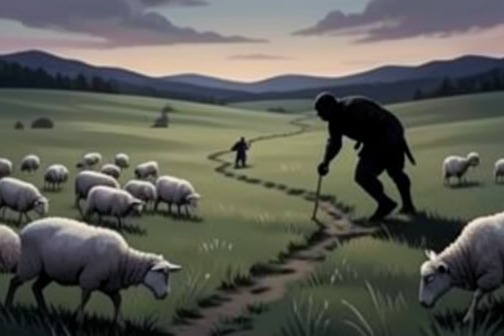
[Gabriel arrives at the Glennkill pasture with his flock](entity:event-recall-event-56ec14334cfb) at a moment when [George Glenn](entity:character-recall-character-george-glenn-db173571c431)’s sheep have lost both their shepherd and their sheepdog. His approach first registers as noise and movement in the distance, then as a new human presence accompanied by dogs and another flock. [Gabriel](entity:character-recall-character-gabriel-bc97a48fb87d) appears to offer care and order, but the arrangement he establishes is also useful to him: it keeps his own sheep on nearby grazing land while he waits for [George](entity:character-recall-character-george-4ccc9776b2d0)’s will to be read. The arrival therefore turns a sudden vacancy into an uneasy new dependence.
## A pasture without its shepherd
The sheep’s first encounter with Gabriel’s approach is not a formal introduction. A dark shape moves quickly along the path toward the meadow, and panic sends the flock galloping uphill without taking their eyes off it. The figure they identify as [God](entity:character-recall-character-god-28f937b98b12) has been pacing the meadow, following a trail with his nose; he walks around the dolmen and up toward the cliffs, nearly going over the edge before looking up at the sea. When he hears the approaching noise, he freezes, turns, and flees along the path toward the moorland. The sheep hear the sound too: a rush like the one they made when they invaded George’s vegetable garden, followed by barking dogs and human voices. Only then do they see a flock moving toward them, unlike any they have encountered before.
The pasture has already changed in George’s absence. On the morning after the sheep find him dead beside the [hay barn](entity:location-recall-location-hay-barn-4478115ff603), a crow perches on his sweater while a rabbit sits nearby; the sheep meet at a distance, near the cliff. The following day, once they venture out, [Mopple the Whale](entity:character-recall-character-mopple-the-whale-c8870eb308f4) leads them to the vegetable garden behind George’s caravan. George had fenced it off, but [Lane](entity:character-recall-character-lane-aadcfcb57a55) pushes back the bolt and [Maude](entity:character-recall-character-maude-a64555802aa1), [Cloud](entity:character-recall-character-cloud-18ae32e774f3), and [Heather](entity:character-recall-character-heather-c102c98231de) begin eating the buttercups, peas, and tomatoes. The neatly planted beds are soon stripped. The sheep fall silent, feel ashamed, and return to the meadow. [Othello](entity:character-recall-character-othello-45ef6b29852c), who did not join the raid, then draws [Miss Maple](entity:character-recall-character-miss-maple-a9c5dcdeac95)’s attention to the garden spade’s usual place beside the caravan: it is missing. Gabriel’s arrival follows this discovery of a world in which familiar human supervision has vanished, but the missing tool and the body by the hay barn give that freedom a disturbing edge.
## The newcomer and his flock
When Gabriel drives the flock toward the meadow at dawn, he is tall against the sky and wears a slouch hat. The sheep initially have high expectations of his abilities as a shepherd. His dogs briefly herd them together, then Gabriel counts them without making a sound. The dogs never bark; they only stare, and that silence revives the sheep’s deep fear of wolves. Gabriel’s attention seems more personal. Standing outside the caravan, as still as the dolmen, he looks at every sheep in turn and gives each one an almost imperceptible nod. Most interpret the gesture as approval and take pride in having been inspected. Othello punctures that optimism: Gabriel was counting them, not praising them. He keeps apart from the others and regards the new shepherd with suspicion.
The arrival also divides the pasture. Cloud suggests asking Gabriel’s sheep about their lives, but Gabriel’s dogs have gathered them at one side of the meadow while he puts up a wire fence. The barrier makes the sheep’s grazing area smaller, particularly around the place where mouse weed grows. Maude objects less to the specific loss of that patch than to the principle of being fenced in. At the same time, the flock is relieved not to have to mingle freely with the newcomers, whom they find strange: short-legged and long-backed, with long, humorless noses, restless eyes, and pale colouring. Their close, curly down offers little wool, although they do not look recently shorn. The sheep cannot understand why Gabriel keeps animals that do not grow a proper fleece, and their uncertainty marks the distance between the two flocks before they know what the newcomers are for.
## Care with a practical purpose
Gabriel’s authority is presented as temporary, but he makes himself at home beside George’s caravan. When [Josh](entity:character-recall-character-josh-7784b47d315f) visits, Gabriel explains that the sheep need looking after until the will is read. He has received support from the management office on the grounds of animal welfare and hygiene regulations, and says that keeping the flock there saves him the cost of grazing his own. He also makes clear that he can stay beside the caravan as long as he likes. Josh leaves reassured; Gabriel, by contrast, reaches for a key he had left on the caravan step and finds it gone, only to see it shining from the roof in a magpie’s beak. The small interruption offers no resolution to the larger uncertainty over who will control the pasture, but it shows that Gabriel’s presence does not give him command of everything around him.
The practical side of his shepherding becomes stark when he takes George’s scythe from the toolshed and cuts grass at the foot of the hill, on the side facing away from the sea. George had said that people who keep sheep could spare themselves a scythe; Gabriel uses one anyway. The sheep have never seen a human grazing in this manner. To them, the blade passes through the grass like a gigantic iron claw, leaving the cut stalks flat and the living meadow altered. Gabriel is gathering grass for his animals, yet the sight appears to the flock as destruction without purpose. Mopple trembles in indignation and horror. What had seemed at first like the arrival of a capable replacement shepherd thus acquires a more troubling aspect: Gabriel’s care is real in its practical function, but it is bound to a different way of using the land and managing animals.
## Significance of the arrival
The arrival changes the flock’s immediate circumstances without restoring the world they knew under George. Gabriel counts and confines sheep, claims the right to stay, and supplies grass, but his flock’s presence narrows the meadow and his methods disturb the animals he is meant to look after. His explanation to Josh makes the arrangement’s mixed motives explicit: care for George’s sheep coincides with cheaper grazing for his own. The sheep, meanwhile, read his gestures and equipment through their own experience—first as signs of approval, then as evidence of counting and cutting.
The scene also reverses the pastoral promise of an open, abundant meadow. In place of George’s watchful, fenced vegetable garden, the sheep now face a divided pasture, silent dogs, and a scythe that makes the act of feeding look like violence against the grass. Gabriel’s arrival is not simply the solution to the flock’s abandonment. It begins a new contest over space, care, and the meaning of shepherding, while the will’s pending reading leaves his authority provisional.
Event 8
Failed nighttime break-in at George’s caravan
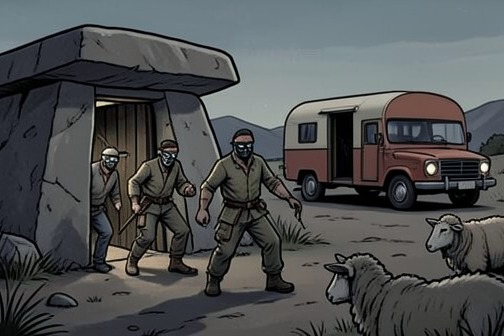
The failed nighttime break-in at [George](entity:character-recall-character-george-4ccc9776b2d0)’s caravan turns the sheep’s watchful attention to human belongings into a test of what those belongings conceal. From beneath the dolmen, they witness three men searching for a way into George’s locked caravan, then see the attempt collapse when a car arrives. The caravan remains unopened, but the scene discloses why its contents matter: the men believe it holds contraband grass and fear the consequences if it is found.
## Background and Discovery
The episode begins with Maple explaining her theory that people and their possessions are connected, and that watching the possessions might lead the sheep to the murderer. As [Maude](entity:character-recall-character-maude-a64555802aa1) squeezes in beneath the dolmen with the others, a torch beam sweeps past and settles on George’s caravan, moving over its walls as if its bearer is looking for somewhere to hide. The sheep are already concealed when the visitors arrive, and their shelter lets them observe without being noticed.
The group consists of [Tom O’Malley](entity:character-recall-character-tom-o-malley-34b5322bdb58), [Harry the Sinner](entity:character-recall-character-harry-the-sinner-6da24bf545ce), and a tall, thin man named [Josh](entity:character-recall-character-josh-7784b47d315f). They wear stocking masks, but their voices and other familiar details betray them to the sheep. Tom’s voice is recognizable, though the sheep notice that he does not smell of drink and nearly fail to recognize him. Harry is recognized from the previous day. The men present their activity as something they must do for [Glennkill](entity:location-recall-location-glennkill-d43fed88eba6), but Josh rejects the pretence of civic enthusiasm and insists that they should stop talking and get the van open to look for the stuff.
## The Attempt on the Caravan
The three men approach the door in a formation the sheep can make out in the moonlight: two stout figures and Josh’s tall, thin one. Metal glints and keys rattle for a long time, but none fits the lock. Harry confirms that the key will not work. Josh kicks the door three times, then peers through the caravan’s two small windows; because he is tall, he does not have to stand on tiptoe to look inside. The physical details make the obstacle plain: the men have reached the caravan and tried its lock, but they have not gained entry.
Harry proposes breaking the door down because, he says, they need the grass. Josh resists, calling that a crime. Harry answers with scorn, arguing that disposing of evidence would hardly be legal either. If the drugs are discovered there, he warns, Glennkill’s plans are finished: the Faerie Dolmen, pony rides, Celtic Cultural Center, whiskey specialities, and seaside hotel all stand to lose their prospects. His list reveals the scale of the men’s anxiety. The possible contents of one caravan threaten not only an individual secret but a proposed transformation of the village and its view into a tourist venture.
Josh questions whether any drugs are inside. Harry counters that George could not have kept his head above water through his few sheep alone, and recalls that George had rejected offers to sell. In Harry’s account, the land’s view has been wasted on sheep, and [George’s death](entity:action-recall-action-4384f06c6fc4) now offers an opportunity to advance their plans. Yet publicity connecting Glennkill with the drugs trade could undo that opportunity. The exchange makes the break-in a struggle over evidence as much as property: they want to find and remove the grass, but they also fear what discovery would expose.
## Interruption and Aftermath
The men do not resolve their disagreement before Tom notices a car approaching without headlights. The sheep had heard it earlier. Its engine purrs along the road and then falls silent, and the three men scatter. Harry doubles back and forth with practiced speed; Josh bends his long back to run faster. All three race past the startled sheep and climb the ladder into the hayloft. The sheep, by contrast, hold their nerve. Their observation turns the sudden flight into a reversal: the people who came to search the caravan are now hiding from an arrival they cannot identify.
The newcomer walks from the paved road toward the caravan without reacting to the sheep or their confused movement in the meadow. He does not kick the door. Instead, he knocks in a distinctive sequence—one short knock, two long ones, then another short one—and waits before silently working on the lock. A faint metallic click sounds, but the door stays shut. He eventually turns and walks back across the fields. The episode does not identify him or establish what he intended to do, and it does not show him entering the caravan. His arrival interrupts the first group’s attempt, while his own effort also ends without opening the door.
## Significance
The scene advances the investigation through watching rather than confrontation. Maple’s attention to human possessions supplies the guiding idea; the caravan becomes a focal point because several people are willing to approach its locked door, and because the sheep overhear what they hope to find inside. The men’s fear of public exposure also links George’s private, hidden contents to the economic future they imagine for Glennkill.
The caravan’s lock is the episode’s practical limit and its narrative hinge. Keys fail, Josh’s kicks do nothing, and the later metallic click still leaves the door closed. The sheep learn that the men are seeking contraband grass, but the attempted entry yields no recovery of it and no answer about the unidentified visitor. The event therefore sharpens the mystery without settling it: a watched possession points toward concealed wrongdoing, while remaining physically inaccessible.
Event 9
George Glenn’s funeral
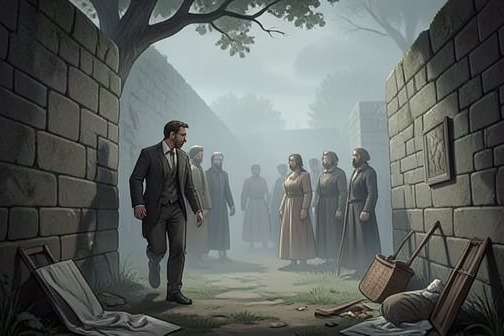
[George Glenn’s funeral](entity:event-recall-event-002860480311) is [Othello](entity:character-recall-character-othello-45ef6b29852c)’s first encounter with a human burial, and its significance lies in the contrast between public ceremony and private recognition. While the mourners gather and [God](entity:character-recall-character-god-28f937b98b12) speaks, Othello identifies [George](entity:character-recall-character-george-4ccc9776b2d0) in the coffin by scent and remains the one mourner who thinks about the man himself. The service also releases a memory of George saving Othello and promising a journey to [Europe](entity:location-recall-location-europe-90be8cc79c46) that never came to pass, ending in Othello’s insistence on justice.
## Approach to the Burial Ground
Othello reaches the funeral by following a high drystone wall through the mist. Voices murmur beyond it, unusually hushed and excited; he slips through a small wrought-iron gate, working its latch with a front hoof, and shuts it behind him with his head. His remembered experience in the circus has made such an entrance possible, a practical skill that allows him to cross into a human gathering unnoticed.
At first, the place resembles a carefully arranged vegetable garden: straight paths, square beds, freshly turned earth, and human figures moving toward one point. But the smell overturns that impression. The vegetation seems unnatural and unappetizing, and an old smell of death drifts along the gravel. Othello remembers Sam, a foolish man who had been put in charge of a pit behind the zoo’s elephant house. The animals knew the pit’s reputation: when Sam returned, even the goats left him alone and the carrion eaters watched him. He smelled of ancient death. That association lets Othello recognize the burial ground not by its layout but by what the earth holds.
## The Funeral and Its Mourners
This is Othello’s first funeral, but he behaves with composed attention. Black and serious among the gravestones, he listens to the music and occasionally munches a pansy. When the brown coffin is brought forward, he knows by its scent who is inside. His recognition precedes any human announcement and gives the scene a private certainty amid the formal ritual.
Othello has already scented God swaying solemnly in the mist. During the service, God speaks about himself, while [Kate](entity:character-recall-character-kate-ba739b4bb276) cries. The ceremony is present, but George seems absent from the mourners’ thoughts: Othello concludes that nobody is thinking about the man in the coffin except him. The contrast is pointed rather than explained. The people have gathered around George’s burial, yet Othello’s sensory knowledge and remembered bond make him the only one who appears to attend to George as an individual.
## Othello’s Memory of George
The coffin brings Othello back to the first time he saw George. The memory begins in cigarette smoke, with blood running into Othello’s eyes and his legs trembling from exhaustion. A dead dog lies beside him, but death has become ordinary in the world he knows: another dog will come. Othello struggles to keep his eyes open. When they close, he experiences a brief blackness and hears a voice warn that closed eyes mean death. He has no objection to being dead, yet obeys and opens them.
George’s green eyes hold his attention until Othello’s legs stop shaking. Othello then turns toward the door through which the dogs have been coming and lowers his horns. The memory binds George’s arrival to Othello’s survival: George’s interest gives the exhausted ram something to hold on to, and Othello’s next gesture is not surrender but readiness to face the dogs. A little later, still bleeding, he lies in the back seat of George’s stationary old car while night presses against its windows. George, triumphant, announces, “We’re going to Europe.”
## The Unfulfilled Promise
The funeral returns the memory to its unresolved ending. George had been wrong; he and Othello never went to Europe. The promise had offered a destination beyond the circumstances in which George found him, but the funeral makes its nonfulfilment unavoidable. Othello’s repeated thought of justice is therefore attached both to [George’s death](entity:action-recall-action-4384f06c6fc4) and to the journey that never took place. The passage does not explain what justice would require. Instead, it closes on Othello’s insistence, leaving the word suspended between the dead man’s fate, the forgotten rescue, and a promise that the funeral cannot redeem.
Event 10
George is poisoned and fatally stabbed with a spade
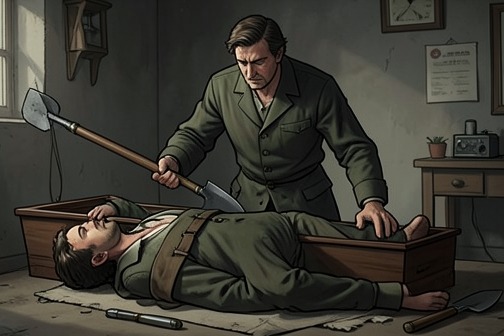
[George](entity:character-recall-character-george-4ccc9776b2d0)’s murder is presented not as a witnessed scene but as a sequence reconstructed afterward: poison first, then a spade thrust into a body that was already dead. That distinction changes the apparent meaning of the weapon. To [Beth](entity:character-recall-character-beth-c520a0bef2d7), it belongs to village superstition and spiritual dread; to [Miss Maple](entity:character-recall-character-miss-maple-a9c5dcdeac95), it points toward McCarthy and a calculated effort to make one death recall another.
## The police account and Beth’s response
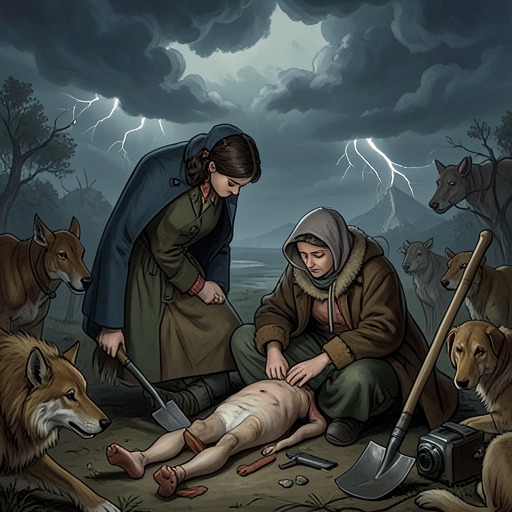
Beth tells the red-haired woman that she spoke to the police and was the only villager to do so. The police said George had been poisoned, had fallen asleep peacefully, and was struck with the spade only after he was dead. Beth stresses the order of events because it makes the spade something other than the cause of death: the killing had already taken place before the conspicuous blow was delivered.
The police, Beth says, may not think the reason for this staging matters much. She does. Years of taking pamphlets from door to door have convinced her that the village is heathen at heart, and she fears that its silence will smother any reckoning. Her account therefore joins a concrete forensic sequence to a broader grievance: [George’s death](entity:action-recall-action-4384f06c6fc4) has become another subject the community would rather leave unspoken.
## A death read through superstition
Beth also interprets the scene through an old belief that nobody should approach a corpse during the first hour after death, because the [Devil’s hounds](entity:creature-recall-creature-devil-s-hounds-3d83bbd8d97a) are said to guard it and wait to swallow the dead person’s soul. In her telling, George’s soul belonged to the Devil; she imagines the horror it must have felt beside the body and the spade. This is Beth’s supernatural interpretation, not an explanation supplied by the police.
The image gives the spade a second, symbolic presence. The police account makes it a blow delivered after death; Beth’s story places it beside a soul supposedly trapped in fear. She connects that spiritual unease to [Glennkill](entity:location-recall-location-glennkill-d43fed88eba6) itself, arguing that the village cannot live again until its black sheep has left the flock. Her language makes the murder both a private death and, in her view, a communal stain that must be expelled.
## Miss Maple’s link to McCarthy
Miss Maple rejects the idea that the spade is incidental. Spades are not ordinarily dangerous, she observes, and the flock’s own spade had spent years in the toolshed. What matters to her is the resemblance between George’s staged death and McCarthy’s death: two people have died with spades involved, although George was actually poisoned. She concludes that whoever murdered George wanted to remind someone of McCarthy.
[Mopple the Whale](entity:character-recall-character-mopple-the-whale-c8870eb308f4) suggests the butcher as a possible target because the butcher knew about McCarthy. Miss Maple considers competing explanations rather than settling the question. Perhaps the display was a warning to the butcher, whom the villagers fear despite disliking him; perhaps, instead, someone wanted the old matter exposed and used George’s murder to make it come out. She also considers that the murderer, having failed with George, may now have the butcher in view. These remain conjectures, but they make the spade’s staged role central to the flock’s attempt to understand the murder.
## What the murder leaves unresolved
The evidence establishes a sequence—poisoning, peaceful sleep, and a spade blow after death—without identifying the killer or proving why the body was struck. Beth’s fear of village silence and Miss Maple’s theory about McCarthy offer sharply different ways to read the same detail: one sees a community refusing to confront a spiritual and moral pollution; the other sees a message composed for someone who knows the earlier death.
That uncertainty keeps the weapon from closing the case. The spade appears to explain the killing, but Miss Maple’s reasoning turns it into a clue about what the murderer wanted others to remember—or reveal. George’s death thus becomes a point where the village’s silence, Beth’s dread, and the flock’s investigation meet.
Event 11
Weasel McCarthy’s killing and concealed body
[Weasel McCarthy’s killing and concealed body](entity:event-recall-event-7c58f28a13c0) become a turning point in the flock’s understanding of the secret surrounding [George](entity:character-recall-character-george-4ccc9776b2d0): the discovery establishes that McCarthy did not die naturally, while later sheep infer that George’s knowledge had made him dangerous to older humans. The evidence identifies the body and hints at a wider human conspiracy, but does not establish who killed McCarthy or what precisely happened to him.
## Discovery Beneath the Stones
As [Melmoth](entity:character-recall-character-melmoth-40a40f9a8507) and the others worked at the slope, pebbles shifted and a large body emerged. Melmoth stepped back to avoid the falling stones. The corpse’s limbs lay at odd angles; once the second leg, thin torso, arms, and face came into view, the butcher recognized [Weasel McCarthy](entity:character-recall-character-weasel-mccarthy-79af796a6639). The dogs sniffed curiously at the body, while Melmoth, exhausted and silent, made no attempt to escape.
George bent over McCarthy and concluded that the death was not natural. [Ham](entity:character-recall-character-ham-d7883aa636d4) acknowledged the discovery but stayed back, then suggested fetching the police. The exchange marks the change from uncovering an unexplained presence in the stones to recognizing a possible crime. The body’s concealment had kept that death out of sight; its exposure made it impossible to treat as an ordinary passing.
## George’s Suspicion
When the butcher explained that people had suddenly begun talking about McCarthy after ignoring him for weeks, George struck his forehead—a gesture associated with his moments of insight. He concluded that the people involved were not just one or two individuals, but all of them. The butcher did not understand whom George meant, and the scene offers no confirmation of the accusation or identification of the people he suspects. His reaction nevertheless gives the discovery a broader reach: McCarthy’s death appears bound up with a secret shared beyond the dead man himself.
## The Secret and Its Consequences
Later, [Miss Maple](entity:character-recall-character-miss-maple-a9c5dcdeac95) reasoned that children had learned to fear George from older humans, although he had never hurt anyone. In her account, George threatened those adults because he knew the secret. That interpretation connects the hidden body and the sudden attention surrounding McCarthy to George’s own danger, without resolving the precise link between the two deaths or naming McCarthy’s killer.
The episode therefore offers both a concrete revelation and an unresolved pattern. McCarthy is identified, and George recognizes signs of unnatural death; beyond that, the evidence remains partial. The body’s emergence exposes the violence beneath a long period of silence, while the sheep’s later reasoning suggests that the secret—not merely the corpse—continued to threaten those who knew it.
Event 12
George and Ham discover McCarthy’s body and keep it secret
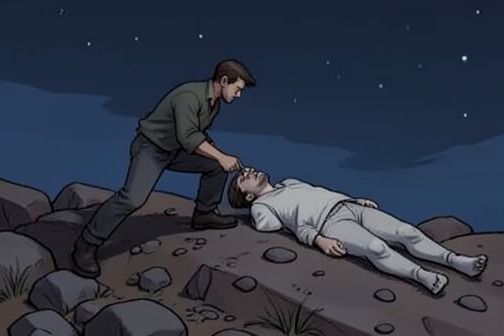
[George and Ham discover McCarthy’s body and keep it secret](entity:event-recall-event-45778bc6f015). The discovery in the [Old stone quarry](entity:location-recall-location-old-stone-quarry-469333bb7cce) links a hidden killing from seven years earlier to the silence and suspicions surrounding [George’s death](entity:action-recall-action-4384f06c6fc4), making the quarry more than a place where a body was buried: it is where [George and Ham](entity:relation-recall-relation-george-and-ham-e3dd9aebfcb3) first chose not to involve the police.
## Discovery in the Quarry
While separated from the flock, [Melmoth](entity:character-recall-character-melmoth-40a40f9a8507) spends a cold November night huddled in a hawthorn hedge, then roams the wintry moorland alone. From a hill he searches the horizon for sheep, but sees none; later, at the pebbly mound in the Old stone quarry, he slips beneath a human leg bone and hides in the shadows as dogs pant and the butcher catches his breath. [George](entity:character-recall-character-george-4ccc9776b2d0) arrives behind them. The light shifts back to the mound, revealing the pale leg against the night sky. At first the men’s attention is on Melmoth, but the bone changes the scene: what had been a chase becomes the discovery of a human body.
## Identifying the Body and Withholding the Police
George puts on his work gloves and climbs the unstable pebbly slope. Pulling at the exposed leg, he loosens the stones until a large body emerges; Melmoth steps back to avoid the falling pebbles. The butcher recognizes the dead man as [Weasel McCarthy](entity:character-recall-character-weasel-mccarthy-79af796a6639). The discovery changes the encounter from a search for a missing sheep into a confrontation with a concealed human death, and George’s inspection confirms that McCarthy did not die naturally: he has minor wounds and bruises, sharp wounds consistent with a knife, and a blood-covered head bearing what appears to be the fatal injury. To Melmoth, watching from the shadows, the injuries seem entirely natural, an interpretation that exposes how little he can make of the humans’ alarm.
[Ham](entity:character-recall-character-ham-d7883aa636d4) proposes fetching the police, but George refuses to treat McCarthy’s death as an ordinary case. He says they would call the police if it were anyone else, then insists that something is wrong. His decision keeps the discovery out of official hands and draws Ham into the silence surrounding the body. The choice is not explained at the quarry; it becomes one of the event’s central unanswered questions, binding the two men to a secret whose significance will emerge only years later.
## The Secret's Delayed Return
The discovery acquires a wider history when George makes a cryptic accusation about the people who had ignored McCarthy: he concludes that it was all of them, without explaining at the quarry whom he means or what they had done. The statement leaves collective responsibility suspended rather than resolved. Years later, [Beth](entity:character-recall-character-beth-c520a0bef2d7) dates a change in the community to seven years earlier, when she returned from six months in Africa to find more superstition and less fear of the Lord. She says George was affected more than anyone and became increasingly reclusive. Her account places his withdrawal in the same period as the old killing, though it does not explain exactly what happened or establish a direct cause.
The public record [Rebecca](entity:character-recall-character-rebecca-a2bff63b7d1a) uncovers gives the concealed body a name and a date. In newspaper files from seven years earlier, she finds that [Wesley McCarthy](entity:character-recall-character-wesley-mccarthy-bb180b8ff06f) was reported murdered in the [stone quarry](entity:location-recall-location-stone-quarry-50e8256a9378); an anonymous caller notified the police, but there were no suspects or arrests, and the story quickly disappeared from the headlines. Beth recognizes the name as Weasel McCarthy, the man already known to the sheep through the discovery at the quarry. The gap between an anonymous report and a case without an arrest echoes the earlier decision not to take the discovery to the police, while the newspaper’s brief attention shows how quickly the killing vanished from public view.
The flock later turns that silence into a question about human memory and trust. [Miss Maple](entity:character-recall-character-miss-maple-a9c5dcdeac95) recalls that [God](entity:character-recall-character-god-28f937b98b12) said no one had told him anything and found the omission suspicious: if people had acted as a flock, she reasons, they might have felt safe enough to tell him, as they had in McCarthy’s case. She also notes that God had not given them away then, despite disliking George. [Mopple the Whale](entity:character-recall-character-mopple-the-whale-c8870eb308f4) counters [Cloud](entity:character-recall-character-cloud-18ae32e774f3)’s suggestion that the people may simply have forgotten, observing that humans still remembered McCarthy after seven winters. The sheep’s discussion makes the old crime not merely an unreported death but a continuing piece of shared knowledge, preserved even as its circumstances remain obscure.
The novel also returns to concealment through a separate object associated with Melmoth. George finds a narrow thread buried deep in the sheep’s fleece, cuts it with a knife, and retrieves a smooth, shining key. Melmoth remembers that George had tied it around his neck because he was the wildest of the flock; after taking it, George walks away without looking back. This later gesture does not explain McCarthy’s murder, but it repeats the event’s pattern of hidden things and withheld explanations, leaving the key’s significance distinct from the quarry secret.
## A Later Visit and the Limits of What Is Told
Beth’s account of George’s visit on the Sunday before last gives the old silence a present-day echo without resolving the quarry’s unanswered questions. Late in the evening, George knocked at her door. She began speaking about the Gospel, as she had whenever they met, but this time he gently stopped her, saying that what he had come to discuss was important. Beth let him in; the moment resembled something she had once imagined, yet his purpose was different. Her recollection shows how long their conversations had followed the same pattern, and how a break in it could become charged with meaning. It does not, in the evidence available here, explain the murder of Weasel McCarthy or George’s earlier refusal to call the police. Instead, it leaves the old discovery within a larger history of postponed speech: the body was found, the question of who was responsible remained unresolved, and the people around George continued to approach the past through fragments and belated disclosures.
Event 13
Rebecca questions Beth about George’s life and death
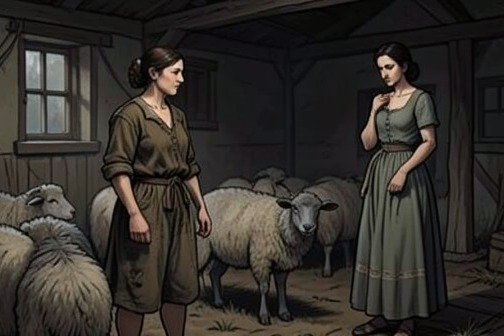
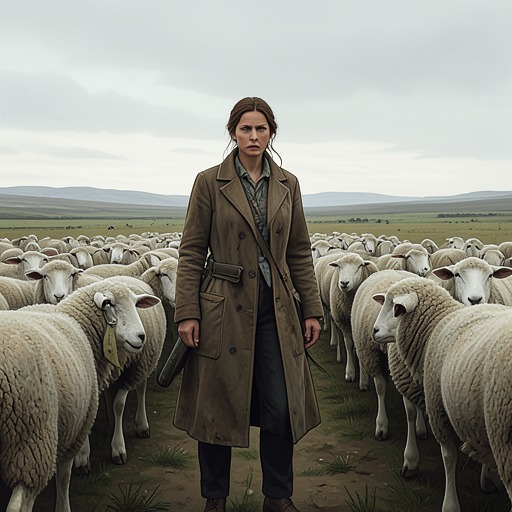
[Rebecca](entity:character-recall-character-rebecca-a2bff63b7d1a)’s interview with [Beth](entity:character-recall-character-beth-c520a0bef2d7) is both an inquiry into [George Glenn](entity:character-recall-character-george-glenn-db173571c431)’s death and an encounter with the damage left by his life. The sheep know, by scent, that Rebecca is [George](entity:character-recall-character-george-4ccc9776b2d0)’s daughter; Beth’s recollections add the picture of a man preparing to leave [Glennkill](entity:location-recall-location-glennkill-d43fed88eba6), while her suspicions about [Ham](entity:character-recall-character-ham-d7883aa636d4) point toward another possible source of danger. Yet the scene’s sharpest turn is not an accusation. Rebecca comes asking for what Beth understands as forgiveness, and the investigation becomes inseparable from the estrangement it is trying to understand.
## Identity and Context
The inquiry begins in the wake of [George’s death](entity:action-recall-action-4384f06c6fc4). His body had been found in the grass beside the [hay barn](entity:location-recall-location-hay-barn-4478115ff603), with a spade protruding from him; the sheep gathered to consider what had happened while trying to keep panic at bay. For Rebecca, however, the case is not merely a mystery about a dead shepherd. The sheep have recognized the family scent in her sweat, skin, and hair, and concluded that she is George’s daughter. They are surprised that George had a child, and unsure what that connection means to humans, for whom parentage may carry a weight it does not have in their own flock.
That uncertainty gives Rebecca’s questions a double force. She is investigating a man whose life she did not fully know, while the sheep observe that the relationship itself may explain why knowledge was missing. Their view remains partial: they can identify a family resemblance through scent, but cannot tell what Rebecca and George meant to each other or why they were divided. The investigation therefore moves between evidence about George’s public life and the private history neither the sheep nor Rebecca can initially see in full.
## Beth’s Recollections and Suspicions
Beth receives Rebecca with agitation. She objects that Rebecca has come to her despite knowing so little about George, and demands to know what she wants. Rebecca answers that Beth would probably call it forgiveness. The reply leaves Beth thunderstruck: in a single exchange, the interview shifts from fact-finding to the unresolved history between the two women and George. Rebecca’s quietness does not settle what happened between them, but it makes clear that her presence is not driven by curiosity alone.
When Rebecca asks why George had been away so often, Beth says she does not know what he was doing. She remembers him dressing well in a suit and white shirt, looking ten years younger and like a gentleman when he went away. People talked, but Beth says she did not believe the gossip; she thought he went to Dublin, to offices and banks, and wanted to get away from Glennkill. When Rebecca asks whether someone did not want him to leave, Beth nods. Her account suggests that departure mattered to someone, but does not identify who or establish why George was prevented from going.
Beth also directs Rebecca toward Ham. She describes his piety as a performance and says people are afraid of him, while he seems afraid himself. His butcher’s shop has a CCTV camera, installed long before such equipment was familiar locally; Beth finds it suspicious that a butcher would have one when even the bank did not. She recalls confronting him about it at the church [Christmas](entity:time-recall-time-christmas-a573265d0167) collection, where he became red with anger and embarrassment. These are Beth’s observations and suspicions, not proof of Ham’s involvement. They nevertheless widen Rebecca’s inquiry beyond the family conflict and toward the secrets that may be concealed in the village.
## The Straw Figure and George’s Absences
The conversation also turns to a small bundle of straw on Beth’s table. It has been tied into the shape of a person, with a twig pushed through its body. Beth offers the possibility that it was a silly trick by children. She remembers that they called George the Goblin King behind his back and feared him, a memory that places his isolation in the local imagination without explaining who made the figure or what it was intended to signify. The object resembles a crude, pointed effigy, but Beth does not claim to know its maker or meaning.
Her description of George’s absences complicates the image of a settled shepherd who simply belonged to the pasture. He dressed for those trips, went away repeatedly, and apparently wanted to escape Glennkill. Elsewhere, local men speculate that George’s land and a possible drug trade lay behind his conflicts with them: they recall his hostility toward tourists and his refusal to sell, and suggest that boats brought goods ashore by night. That account is allegation, not confirmation, and it sits uneasily beside Beth’s belief that George went to Dublin on personal business. The investigation accumulates competing explanations without allowing any one of them to stand as the answer.
## The Personal Meaning of the Inquiry
A later story Rebecca tells the sheep casts the estrangement between herself and George in a clearer, more painful light. In her tale, a little girl has a secret father as well as an unsecret one. She and the secret father are fond of each other, but after a quarrel she tries to make him angry, and they do not speak for a long time. A letter eventually tells her that he plans to travel to [Europe](entity:location-recall-location-europe-90be8cc79c46) and wants to see her first. She hides her joy and keeps him waiting; he waits himself to death. The story does not name its characters, but its details connect Rebecca’s knowledge of a delayed meeting with the father she has lost.
That later telling gives emotional shape to the earlier request for forgiveness. Rebecca’s investigation is not resolved by Beth’s testimony: it produces clues about George’s movements, possible pressure on him to stay, and Ham’s suspicious behavior, while leaving essential questions open. Its decisive revelation is instead intimate. George was Rebecca’s father, and their separation was bound up with a missed chance to meet before his death. The inquiry therefore makes the case’s central absence twofold: the unexplained circumstances of George’s death and the time father and daughter did not recover.
Event 14
Melmoth’s return to the flock
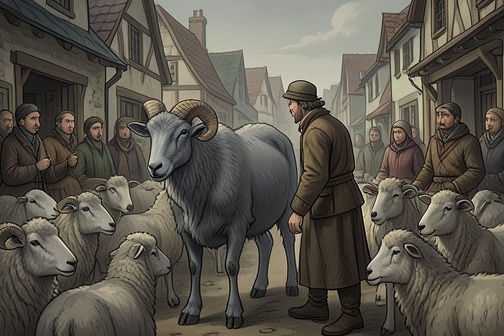
[Melmoth’s return to the flock](entity:event-recall-event-1f02c51d66a3) transforms a cautionary legend into a living presence—and, through his account of the fifth night, gives the sheep a crucial clue about [George Glenn](entity:character-recall-character-george-glenn-db173571c431)’s death and departure. The gray ram whom lambs had been taught to fear reappears as [Sir Ritchfield](entity:character-recall-character-sir-ritchfield-b2c8606df44b)’s identical twin: at once a homecoming, a challenge to the flock’s stories, and a witness to the night [George](entity:character-recall-character-george-4ccc9776b2d0) died.
## The return of a supposed ghost
[Melmoth](entity:character-recall-character-melmoth-40a40f9a8507)’s reappearance throws the flock into uproar. He was not merely a ram who had gone missing. His absence had become a warning passed from older sheep to younger ones: he had leaned too close to the abyss and never come back; he had eaten strange fodder and died. Mothers had used his supposed fate to keep lambs obedient, and the [Winter](entity:time-recall-time-winter-d51e63751f76) Lamb, who had heard more Melmoth horror stories than anyone, now faces the living ram himself. The return exposes how the flock had made a cautionary figure out of someone whose fate it did not know.
The confusion deepens because Melmoth looks exactly like Sir Ritchfield. [Heather](entity:character-recall-character-heather-c102c98231de) sees two versions of the same ram, while [Miss Maple](entity:character-recall-character-miss-maple-a9c5dcdeac95) identifies the newcomer as Melmoth. To the flock, he is both familiar and impossible: the vanished sheep has returned in the likeness of its lead ram. Some call him the one who got away scot-free, with uncertainty over whether the phrase is an insult or a tribute. Once Ritchfield explains why no sheep may graze on George’s Place, however, Melmoth is initially received with friendliness. The return does not simply restore an old member; it forces the flock to decide how the returned outsider belongs.
## A twin changes places
The resemblance makes leadership a practical problem. The sheep would prefer to keep Sir Ritchfield as lead ram, but they cannot reliably distinguish him from Melmoth. Meanwhile, Ritchfield himself has changed: he is more cheerful and playful, almost as daring as a young ram, and no longer seems interested in leading. He spends much of his time close to Melmoth, and the flock has never seen him so happy. Their reunion is therefore not just a matter of mistaken identity. It changes Ritchfield’s bearing and unsettles the role the flock had expected him to continue filling.
Ritchfield answers the return with a rule that reshapes the meaning of [Melmoth’s disappearance](entity:action-recall-action-c8bebbd5264e): no sheep may leave the flock unless that sheep comes back again. The exception makes return part of the rule rather than proof that the rule has failed. Melmoth’s presence gives the flock a living example of departure followed by re-entry, while Ritchfield’s response makes room for that history without abandoning the flock’s concern about sheep going missing.
## The story of the fifth night
Melmoth turns his return into a telling. He invites the flock to hear the story of the fifth night, and the sheep gather beneath the shade tree, where he rests on old leaves. Even the Winter Lamb watches from behind the trunk. Though the day is hot and still, Melmoth’s storytelling makes the flock shiver and race through darkness with him. His tale reaches them not only as words but as an experience that seems to carry the cold and fear of the night into the summer meadow.
The story also connects Melmoth’s long absence to George. When Miss Maple asks how he knows George is dead, Melmoth explains that the signs were impossible to miss: the blue-eyed man had brought his pale-eyed flock, the sheep had plundered the vegetable garden, and people were trampling the grass. More directly, he had seen George’s body at night. Melmoth found him before the carrion beetles, while some warmth of life remained. He walked around the body three times in each direction, leapt three times, and put a hoof on George’s heart. He had hoped George might see him once more and know he had made it back, but he arrived one sunset too late.
That account explains the hoofprint on George’s body. Miss Maple recognizes Melmoth as the apparent wolf’s ghost: the shaggy shape, glowing eyes, fluid movement, and crows on his back had made the returning ram seem supernatural. What the sheep had treated as a ghostly trace is instead evidence of Melmoth’s presence beside George. His return thus supplies a witness to the body without identifying who drove the spade into it.
## Departure, return, and the flock’s history
After Melmoth disappears into the gorse hedge, the meadow seems strangely empty. Ritchfield insists that Melmoth has only gone for a stroll and will return, repeating the new rule as reassurance. The moment echoes the earlier disappearance but does not resolve it into permanent loss: the flock is left waiting, with Ritchfield’s confidence standing against the old legend of a sheep who never came back.
Miss Maple draws a further conclusion from Melmoth’s story. On the night he recounts, George discovered that his was the wrong flock because it had killed [Weasel McCarthy](entity:character-recall-character-weasel-mccarthy-79af796a6639). In her comparison, the horror was like living among sheep and discovering that the others were wolves. Melmoth’s return does not solve George’s murder, but it changes how the flock understands George’s own departure and the hoofprint at the scene. The legend of the missing ram becomes a route into the flock’s buried history: a return that restores one sheep while bringing the truth about another’s isolation closer to view.
Event 15
Othello’s nighttime entry into the church and discovery of the secret conversation
[Othello](entity:character-recall-character-othello-45ef6b29852c)’s nighttime entry into the church becomes a turning point in the flock’s investigation: the ram goes looking for [God](entity:character-recall-character-god-28f937b98b12), but finds [Ham](entity:character-recall-character-ham-d7883aa636d4) and overhears a secret that binds the two men to [George’s death](entity:action-recall-action-4384f06c6fc4). The scene converts Othello’s private anger into an unexpected discovery, then ends not with a duel but with God fleeing from the animal he had failed to notice.
## Causes and Setting
Othello enters with revenge in mind. He has waited outside until the place is quiet, and his rage has cooled into patience; he intends to challenge God for the suffering and indifference he sees in the world. But once inside, the church unsettles him. Its organ, empty benches, platform, microphone, rostrum and small bench evoke a circus, while an iron fence lined with candles makes the space seem prepared for a cruel performance. Othello imagines animals being driven over the spikes for an audience’s amusement, and connects the scene with what [Cloud](entity:character-recall-character-cloud-18ae32e774f3) had witnessed. The church’s religious setting does not reassure him: to Othello, its arrangement resembles a place where suffering is staged.
The exchange that follows also recalls Cloud’s earlier encounter with God. When she was still a lamb, [George](entity:character-recall-character-george-4ccc9776b2d0) had carried her after trimming her hooves and brought her to the meadow. God came to invite George to give a blessing to the animals. Cloud remembered George’s dislike of him, their argument over the blessing, and how God took her away to his large, cold house and shut her alone in the garden. The recollection makes Othello’s suspicion of God more than a response to the church’s strange appearance; it sits within a history of unsettling encounters between the man and the flock.
## The Unexpected Arrival of Ham
As Othello waits, the church’s door opens and a figure enters: short as a child but broad, moving on wheels. Othello catches the smell of metal, bitter medicine, oil and healing wounds, beneath which lies a scent he recognizes. God welcomes the visitor as Ham and speaks as though pleased to see him recovering and coming to him in trouble. Ham wheels past God without looking at him and goes straight to the wooden figure.
The contrast between God’s gentle welcome and the smell of his sudden bitter sweat tells Othello that God hates Ham intensely. That recognition complicates Othello’s first assumption about the encounter: the two men are not simply united by the church or by their conversation. God appears to resent the butcher, even as he tries to manage what Ham might do. Othello remains hidden and listens rather than confronting either of them, turning his intended challenge into an act of surveillance.
## What Othello Overhears
Speaking through a grating, the voice associated with the wooden figure tells God that it is glad Ham came. It admits that it kept its mouth shut about George but will not do so again, adding that it has a conscience. God’s response is to insist that Ham be left alone. He says he does not know whether the sheep on the cliffs were responsible for what happened to Ham, warns that Ham’s death would bring everything out, and argues that Ham poses no danger. He points to Ham’s cameras, butcher’s shop and television as reasons to consider him content, and says [Kate](entity:character-recall-character-kate-ba739b4bb276)’s presence makes the situation safe because she is free again.
The conversation therefore reveals both an admission and an attempt at containment. God acknowledges that he has concealed something concerning George, while his repeated concern about Ham dying suggests that Ham’s knowledge, or what might emerge if he died, matters greatly. His account of Ham’s contentment sits uneasily beside his evident fear for him. Othello can hear that fear even though it conflicts with the hatred he has scented in God. The men’s words do not explain exactly what happened to George, but they make clear that silence about George has been deliberate and that Ham is entangled in the secret.
## Exposure and Aftermath
Othello’s hidden presence is discovered when God stops speaking and peers through the grating. God pulls back the curtain and finds the ram in the moonlight. Othello answers with a loud, aggressive bleat. God screams, runs past the benches, stumbles, gets up, and leaps over the iron fence and candles before escaping through the small door. Othello does not attack him; the sudden exposure is enough to make the man flee. The church’s apparatus, so menacing in Othello’s imagination, becomes an obstacle God himself must scramble across.
Othello leaves with the other sheep’s shadows beside him and a pale shadow ahead. The narration adds a fourth, shaggy shadow with long curved horns following some distance behind. Its presence remains unexplained in the scene, but it gives the escape an ominous afterimage. At dawn, the flock grazes peacefully, unaware of what happened during the night. The contrast is sharp: the sheep return to ordinary pasture life, while Othello carries away a disclosure that brings the hidden human conflict around George closer to the surface.
Event 16
George’s flock defends the pasture from Gabriel’s flock
[George’s flock defends the pasture from Gabriel’s flock](entity:event-recall-event-a0f88c487a70) in a night-time confrontation over [George](entity:character-recall-character-george-4ccc9776b2d0)’s Place, a grazing ground the flock has set aside as a memorial to its dead shepherd. The defense begins as a simple attempt to hold a boundary against a larger group, but the sheep’s improvised line cannot withstand the pressure for long. [Othello](entity:character-recall-character-othello-45ef6b29852c)’s tactics and [Lane](entity:character-recall-character-lane-aadcfcb57a55)’s appeal for help turn the retreat into a strange, carefully directed dispersal, restoring both flocks to their own enclosures without a lasting fight.
## The pasture and the threat
The immediate alarm comes from [Miss Maple](entity:character-recall-character-miss-maple-a9c5dcdeac95), who wakes to the close scent of [Gabriel](entity:character-recall-character-gabriel-bc97a48fb87d)’s sheep and bleats to rouse the flock. They gather at the [hay barn](entity:location-recall-location-hay-barn-4478115ff603) door and watch the newcomers advance across the meadow. Gabriel’s sheep have broken out of their fenced patch and are grazing toward the barn in a compact, close-set phalanx. In the dark their pale bodies seem to give off a wan light; seen together, they are numerous enough to resemble a machine moving across a field. The danger is not an attack on an individual sheep but the advancing mass of animals, whose grazing threatens to overwhelm the smaller flock’s space.
The threatened ground matters especially because it includes George’s Place. [George’s flock](entity:organization-recall-organization-george-s-flock-e57e05f7ecfd) has voluntarily given up grazing there so that the pasture can remain a memorial to George. The prospect of Gabriel’s sheep eating it bare therefore combines a practical loss of ground with an affront to the flock’s act of remembrance. Mopple reacts with fury, and the flock decides to defend the place rather than accept the incursion. Their response gives collective form to a rule they have chosen for themselves: this piece of land is not simply available forage.
## Othello’s defensive line
Led by Mopple, the sheep trot to George’s Place. Their first uncertainty is tactical: they know what they want to protect, but not how sheep can defend a meadow from other sheep. Othello supplies the answer. He arranges them in a circle, shoulder to shoulder, with their heads turned toward the approaching flock, and takes a position in the middle so that he can lend a hoof wherever the line is threatened. The formation translates an abstract resolve into a visible barrier, each sheep’s place in the ring depending on the others holding theirs.
For a moment, the plan seems straightforward. Then a short-legged young sheep pushes [Cordelia](entity:character-recall-character-cordelia-16682bee45d5) aside and breaks through. Othello gallops over and drives the intruder back out of the defended ground with a single charge. The breach shows both the usefulness and the limits of the ring: Othello can repel one sheep, but the attackers keep pressing, and the defenders are not facing a lone challenger. The pressure forces George’s flock backward step by step. Mopple remains in his original place, like a rock among breaking surf, while Gabriel’s sheep push the others away from the boundary. [Zora](entity:character-recall-character-zora-86e14b4c614c)’s hind legs have already reached the forbidden herbs, a concrete sign of how far the line has given ground.
## A call for help, and a different kind of resistance
Seeing that the circle cannot hold, Othello tells Lane to find [Melmoth](entity:character-recall-character-melmoth-40a40f9a8507). He cannot tell her where to look; she leaves anyway, glad to be running rather than standing in the line, and uses her speed to force a path through Gabriel’s sheep. Othello immediately fills the gap between [Heather](entity:character-recall-character-heather-c102c98231de) and Miss Maple. Heather questions how Melmoth could turn the intruders back if they would not follow him. Othello’s answer is that they will run away from him. The distinction shifts the plan from controlling [Gabriel’s flock](entity:organization-recall-organization-gabriel-s-flock-467c99850625) by command to making it move through fear.
Meanwhile, the defenders struggle with the means of holding their ground. Zora nips one intruding sheep on the nose. The sheep cries out, and although the pushing and resistance continue, the sound leaves George’s flock reluctant to try violence again. Their purpose is to protect George’s Place, not to injure the animals pressing into it; the painful yelp makes that limit felt in the middle of the confrontation. The line has little room to act forcefully without becoming a source of harm itself.
Then Gabriel’s flock suddenly stops shoving and listens to the darkness. A dark body is hunting around them, circling closer. The sheep cannot later recall exactly what follows: flight, panting, crowding together, scattering, and tense expectation run into one another. What they remember is not a rout driven by panic, or a sense that there is no escape. Instead, there is always another step to take, as if someone outside their confusion is herding them with skill. The sequence leaves the pursuer’s identity indistinct in the flock’s recollection, even as its effect is unmistakable.
## The restored boundary
After what seems to be only a short time, the two flocks are back where they belong: George’s flock in the hay barn and Gabriel’s flock behind its wire fence. The immediate contest ends not with Gabriel’s sheep captured or defeated, but with the invasion reversed and the separation restored. Lane stands atop the cliffs, gazing dreamily into the night with shining eyes. Her return to the scene after being sent for Melmoth links her errand to the uncanny intervention, though the flock’s confused memory does not spell out exactly how the dark figure achieved its work.
The defense makes George’s Place more than a disputed patch of grass. George’s flock treats it as a memorial boundary, and the animals defend that meaning through organization rather than through a simple contest of strength. Othello’s circle gives the flock a shared tactic; the pressure exposes its weakness; Lane carries the appeal beyond the line; and the unseen hunter turns the imbalance around. By the end, the pasture is not secured by permanent victory but by the re-establishment of a boundary, with each flock returned to the place from which it came.
Event 17
Zora learns Gabriel’s flock is being fattened for slaughter
[Zora learns Gabriel’s flock is being fattened for slaughter](entity:event-recall-event-cd95b30686dd) when a ram from that flock warns her that the grass [Gabriel](entity:character-recall-character-gabriel-bc97a48fb87d) cuts is part of a fatal process: the sheep eat, grow fat, and die. The discovery changes the meaning of the pasture around her. What looks like feeding is preparation for death, and what looks like shepherding may be the machinery that delivers the sheep to it.
## The pasture and the warning
The revelation unfolds after Gabriel begins cutting grass with [George Glenn](entity:character-recall-character-george-glenn-db173571c431)’s scythe. Until then, the sheep have not seen a human graze. The scythe’s passage leaves the grass flattened and untouched by the sheep, while its sharp, hissing sound makes the work seem less like ordinary pasture care than senseless destruction. Gabriel is gathering food for his animals, but he does not eat it himself; to the watching sheep, his activity has no familiar purpose.
The tool carries its own history. George Glenn used to polish the blade with a red-and-white rag and said that people who kept sheep could spare themselves a scythe. Gabriel’s use of it reverses that assurance. A tool associated with [George](entity:character-recall-character-george-4ccc9776b2d0)’s careful maintenance becomes, in Gabriel’s hand, an instrument of cutting and the first visible sign of a system the sheep do not understand.
[Zora](entity:character-recall-character-zora-86e14b4c614c) approaches a ram at the wire fence after deciding, more than once, that she will not speak to [Gabriel’s flock](entity:organization-recall-organization-gabriel-s-flock-467c99850625) again. She tries to pass him several times before he responds. His first words connect fodder with death; when Zora suggests that he means the cut grass, he clarifies that the danger is not simply the loss of pasture. The sheep themselves are meat. The gap between their ordinary idea of food and his knowledge of their fate opens into what Zora senses as an abyss.
## From feeding to fattening
The ram explains the sequence as he understands it: the sheep eat, become fat, and die. His own sentence trails off when he turns to his personal fate, but Zora recognizes the significance of the flock’s meat-breed status. She recalls that [Mopple the Whale](entity:character-recall-character-mopple-the-whale-c8870eb308f4) is also a meat breed, and that George Glenn had associated the term with being put under the knife. The familiar category suddenly describes a destiny rather than a harmless difference among sheep.
Zora does not receive a complete explanation directly from the ram. She joins his fragments to what she already knows: Gabriel is cutting grass, his sheep are eating it, and they are a breed that grows fat quickly. Her conclusion is an act of interpretation as much as a disclosure. The ram supplies fear and partial knowledge; Zora makes the connection that turns those fragments into a warning about imminent slaughter.
The warning also revises the apparent meaning of Gabriel’s care. The sheep have taken a shepherd’s feeding as evidence of protection, even when Zora has doubted whether Gabriel is a good shepherd. Now the same provision of abundant grass appears to serve a different end. Gabriel’s flock is being fed, but feeding is not the opposite of killing: in this case, it is how the animals are prepared for it.
## Fear, fences, and disbelief
The ram describes more than physical fences. His flock is held by fear, by fast dogs, and by a pattern in which young sheep do not understand what is happening while mother ewes forget from year to year. He suggests that forgetting is itself part of the confinement. The flock’s members are not simply unable to leave; they are kept from seeing the danger clearly enough to act together against it.
Zora asks why the ram does not warn the others or run away, recalling that Gabriel’s flock had attacked George’s Place. The question exposes the distance between recognizing a threat and being able to escape it. The ram answers in terms of fear and control, looking toward Gabriel with an empty expression. His account makes the fence both a visible boundary and the outward sign of a learned helplessness that keeps the flock in place.
When Zora brings the warning back to her own flock, it is met with disbelief. [Heather](entity:character-recall-character-heather-c102c98231de) insists that Gabriel is a shepherd and looks after his sheep, while [Maude](entity:character-recall-character-maude-a64555802aa1) points out that Heather had just said otherwise. [Sara](entity:character-recall-character-sara-c8609d6444c6) asks why Gabriel would kill them. Zora answers that their meat is the reason and explains the connection between rapid fattening and the meat-breed label. She admits that the ram did not state every part of her conclusion directly; she understood from his fear. The uncertainty in how she knows does not make the prospect less frightening, but it helps explain why the others resist believing her.
Mopple the Whale’s response shifts the flock toward panic. He insists that being a meat breed means something else, yet his powerful memory supplies no alternative explanation. His failure to recover a reassuring meaning persuades the others that Zora’s interpretation may be right. Panic breaks out: Maude cries wolf, [Lane](entity:character-recall-character-lane-aadcfcb57a55) and [Cordelia](entity:character-recall-character-cordelia-16682bee45d5) press their heads into each other’s fleeces, and the mother ewes call to their lambs. [Rameses](entity:character-recall-character-rameses-32a5192e28f5) fears that they are now Gabriel’s flock too. The warning has crossed a boundary: the danger is no longer imagined as something that happens only to unfamiliar sheep.
## The pastoral promise overturned
The contrast with the sheep’s own meadow sharpens the discovery. After George Glenn’s death, they had raided the garden behind his caravan, eating its lettuces, peas, radishes, cress, tomatoes, endives, buttercups, and chives. That brief, unruly feast was food taken for themselves once the shepherd’s watchfulness was gone. Gabriel’s cut grass has the opposite significance: food is being provided to make his sheep heavier and more valuable as meat.
The landscape also carries a human history of competing uses. Some locals regard George Glenn’s land as a wasted prospect for tourism and accuse him of profiting from drugs instead of allowing development. Against that human argument over the value of the land, Zora’s discovery brings another hidden economy into view: sheep can be treated not as companions under a shepherd’s care but as livestock being fattened for slaughter. The green pasture remains abundant, yet abundance is no guarantee of safety.
The event’s force lies in the reversal it produces. Grass, usually a sign of life and nourishment, becomes part of a process leading toward the knife. Gabriel’s work is visible, but its purpose is not immediately legible to the sheep; the ram’s warning makes the hidden outcome thinkable, and Zora gives it words her own flock can hear. Their alarm does not resolve the danger, but it changes what they must consider when they look at a shepherd, a fence, or a well-fed flock.
Event 18
The flock overhears Ham and the priest discussing Kate, McCarthy, and George
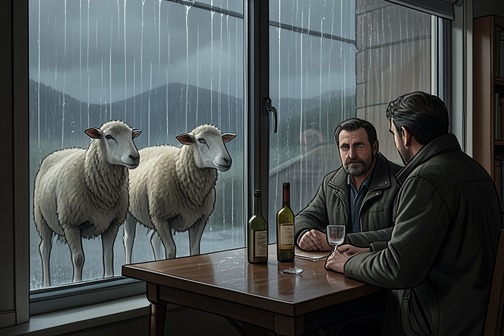
[The flock overhears Ham and the priest discussing Kate, McCarthy, and George](entity:event-recall-event-cd56e3d3ed95) when [Miss Maple](entity:character-recall-character-miss-maple-a9c5dcdeac95), [Mopple the Whale](entity:character-recall-character-mopple-the-whale-c8870eb308f4), and [Othello](entity:character-recall-character-othello-45ef6b29852c) carry out an exercise designed to make them less afraid of the butcher. Watching from outside in the drizzle, they hear a conversation that joins sheep slaughter, human guilt, [George’s death](entity:action-recall-action-4384f06c6fc4), and the chain used in an apparent attempt to implicate [Ham](entity:character-recall-character-ham-d7883aa636d4). The encounter also turns the flock’s fear into a tool: its sudden appearance at the window sends both men into alarm, and the sheep return to the meadow knowing that a fearless gaze can frighten humans.
## The Exercise and the Eavesdropping
[Melmoth](entity:character-recall-character-melmoth-40a40f9a8507) assigns the three sheep to go into the village and watch the butcher until they are no longer afraid of him. The exercise is part of a wider set of trials in which other members of the flock confront particular fears. Miss Maple, Mopple the Whale, and Othello peer through raindrops on a window and see Ham sitting with [God](entity:character-recall-character-god-28f937b98b12), the long-nosed priest, at a table. A bottle and two glasses of golden liquid stand between them. The sheep have gone to observe a threat; instead, they become witnesses to a conversation the men believe private.
The setting gives the eavesdropping its tension. The sheep watch from the dark outside while the men speak indoors, and even Mopple the Whale finds the return journey through the night frightening. He pushes back between Miss Maple and Othello, using their company as a refuge while he keeps watching. The exercise does not instantly erase fear. It makes the sheep stay near it long enough to hear what the butcher and priest reveal.
## [Sheep](entity:creature-recall-creature-sheep-fc2e92cc9afd), Slaughter, and [George](entity:character-recall-character-george-4ccc9776b2d0)
Ham tries to explain how he once justified his work. He had told himself that sheep were bred to be slaughtered and that their deaths were clean and ordinary, unlike those of horses or donkeys. But his account falters when he remembers George. George gave his sheep names, spoke to them, and treated them as individuals; when Melmoth disappeared, George came to Ham and insisted they search for him with the butcher’s dogs. Ham recalls George with unusual warmth, calling him better than the rest, and the memory exposes a contrast between the butcher’s customary view of sheep as livestock and George’s attachment to his flock.
The conversation also reframes the apparitions that have frightened the men. God recalls seeing a black, four-horned ram at George’s funeral. Ham describes a huge white ram that drove him off the cliff and another bright shape he saw in the mist. God recounts a gray, horned ram appearing at a window while he was showing a tourism representative around; he sent the woman to [Beth](entity:character-recall-character-beth-c520a0bef2d7). He also remembers a black, seven-horned ram appearing in the confessional when he expected to speak with [Gabriel](entity:character-recall-character-gabriel-bc97a48fb87d). Both men interpret these encounters as supernatural punishment or vengeance. The sheep hear the accounts, but the scene presents them as the men’s frightened explanations, not as proof of a supernatural cause.
## [Kate](entity:character-recall-character-kate-ba739b4bb276), Alice, and the Chain
Ham admits that he continued to long for Kate after she married George. He says he bought a CCTV camera so he could watch her coming to the butcher’s shop, while insisting that he never touched her. He also claims he did not join the business involving McCarthy, though McCarthy had harmed him. Faced with the question of what might explain the apparitions, Ham returns to his work slaughtering sheep. His words link his unease to the trade he had treated as ordinary, while his fixation on Kate reveals a separate, human source of shame and resentment.
God’s own resentment emerges when Ham challenges him about Alice. God insists that Alice left him and says he still sees her in every woman. Ham answers that all Alice wanted was honesty. The argument shifts the discussion away from abstract sin: Ham accuses God of failing Alice afterward, and God’s hurt response makes clear that their dispute is personal as well as religious. The scene does not resolve their history, but it reveals that God’s talk of sin and penance sits beside an unresolved grievance over his sister.
God then describes his role in a plan involving Kate’s gold chain. He says that someone realized the chain would be useful if it were found at the crime scene, and that he went to retrieve it after [Josh](entity:character-recall-character-josh-7784b47d315f) confessed. Ham identifies Josh as the person God means. Their exchange indicates that the chain was connected to an effort to implicate Ham, while also showing that God knew about the plan and acted to recover the object. The revelation joins the earlier suspicions around George’s murder to the men’s concealed dealings; it does not, by itself, establish every participant’s motive or the full course of the scheme.
## The Sheep Turn Fear Outward
The conversation breaks off when Ham sees something at the window. He shouts that the figure is there and wheels himself rapidly toward the door. God stares at the dark rectangle where, for an instant, three sheep’s heads have appeared in reddish light. The sheep have made themselves visible at the moment when the men are already discussing horned apparitions, and the sight sends both listeners into alarm.
Miss Maple, Mopple the Whale, and Othello trot back to the meadow in the drizzle, pleased that they have frightened the two men even though their own fear has not entirely vanished. Othello takes particular pride in having impressed God with his four horns. Mopple the Whale, who had needed the others beside him on the way there, now keeps pace with Othello instead of dropping timidly behind. The exercise has produced a practical reversal: the butcher and priest, rather than the sheep, are left afraid. For the flock, the encounter is both an accidental source of knowledge about the human world and a lesson in how attention and a steady gaze can change who frightens whom.
Event 19
The murder of Wesley McCarthy
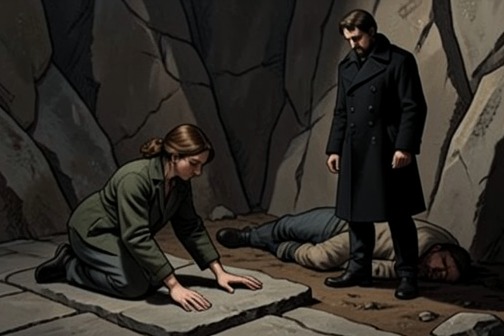
[The murder of Wesley McCarthy](entity:event-recall-event-the-murder-of-wesley-mc-1c4d2eb784a9) is an unresolved killing from seven years before [Rebecca](entity:character-recall-character-rebecca-a2bff63b7d1a) questions [Beth](entity:character-recall-character-beth-c520a0bef2d7), and its significance reaches beyond the discovery of a body in a [stone quarry](entity:location-recall-location-stone-quarry-50e8256a9378). The sparse account of the crime opens onto McCarthy’s land deals, a proposed slaughterhouse that threatened local livelihoods, and a guarded secret that the sheep connect to [George](entity:character-recall-character-george-4ccc9776b2d0) and the [Shepherd’s caravan](entity:object-recall-object-shepherd-s-caravan-7e0363d6f042). The book supplies no killer or definitive motive; instead, it shows how an apparently forgotten murder continues to shape what people fear will be revealed.
## Discovery and the surviving record
Rebecca brings the case back into view after searching newspaper files from seven years earlier. She tells Beth that [Wesley McCarthy](entity:character-recall-character-wesley-mccarthy-bb180b8ff06f) was found murdered in the stone quarry, that an anonymous caller reported the body to the police, and that investigators made no arrest and identified no suspects. The story disappeared from the headlines almost at once. These details establish both the fact of the killing and the thinness of what the public record can explain: the caller’s identity, the circumstances of the murder, and the reason the investigation stalled remain unknown in the account.
Beth recognizes the name as [Weasel McCarthy](entity:character-recall-character-weasel-mccarthy-79af796a6639), the name by which he was known locally. Her reaction reconnects the newspaper report to a past the village had discussed but never resolved. She recalls that nobody knew where McCarthy came from or what he was doing in [Glennkill](entity:location-recall-location-glennkill-d43fed88eba6). He had money, bought [Whitepark](entity:location-recall-location-whitepark-aa674731e73d), and lived there quietly for a time. At first he was popular; after his murder, people claimed that they had sensed something wrong about him from the beginning. That retrospective suspicion sits uneasily beside Beth’s description of his earlier welcome: the village’s judgment changed, but the evidence available to it did not thereby become clearer.
## McCarthy’s money and local power
Beth describes McCarthy’s account of his wealth as a story that persuaded people at the Mad Boar. He presented himself as someone who had started as a small farmer and moved into investment abroad. Locals entrusted him with money, and the first investors even received some of it back. Beth’s derisive recollection suggests why the story initially worked, while the later outcome remains deliberately unspecified; the passage does not establish the precise terms of any fraud or explain how McCarthy acquired all his money.
His influence became visible in the land he bought. He acquired plots gradually, first beside the meadow and then across nearly all the land between it and the village. Beth says he paid well, at a time when local people had little money and few practical choices. They did not initially ask what he intended to do with the property; by the time they understood, it was too late. The killing is thus recalled alongside a broader change in ownership: McCarthy’s presence was not merely a private mystery but a force that altered who controlled the ground around Glennkill.
## The slaughterhouse controversy
The plan for the land was to build the largest abattoir in [Ireland](entity:location-recall-location-ireland-3247a2c8bcbe). When Beth left for Africa, people were urgently discussing ways to stop it, including citizens’ action groups and petitions. When she returned, Whitepark was empty. She had not even heard that McCarthy had been murdered until Rebecca raised the case. The sequence gives the murder a striking place in Beth’s account: it had vanished from her knowledge along with the public campaign, while the intended development itself had also disappeared.
Beth explains why the proposal threatened more than a single business. She points to the smell and animal transports, and says a slaughterhouse would have damaged tourism, bed-and-breakfast businesses, and the Mad Boar. Farmers, too, might have lost a market for their meat. Yet she also identifies a contradiction in local opposition: people could complain about McCarthy forcing his way into the area and still buy meat wherever it was cheapest. Her account does not prove that the slaughterhouse plan caused the murder. It does show the conflicting economic interests around McCarthy’s land and why the aftermath cannot be reduced to a simple division between a united village and an outsider.
## The murder’s continuing implications
The sheep construct a further link between McCarthy’s murder and [George’s death](entity:action-recall-action-4384f06c6fc4). [Miss Maple](entity:character-recall-character-miss-maple-a9c5dcdeac95) reasons that [Gabriel](entity:character-recall-character-gabriel-bc97a48fb87d) was already the lead ram when McCarthy was murdered and believes that George and the butcher had made sure the sheep were safe. In her interpretation, Gabriel fears that what happened will come out, and expects the Shepherd’s caravan to be the source of disclosure. This is the sheep’s inference, not a solved account of either killing; the passage gives their suspicion force without confirming its full explanation.
Later, [Inspector Holmes](entity:character-recall-character-inspector-holmes-a9f397fe1c2a) receives a videocassette from a discreet man who says it will tell him all about McCarthy and could help his career. The man disappears before Holmes can question him. The cassette therefore revives the possibility of evidence without revealing its contents or resolving the case in the scene. Holmes’s unease extends beyond the Glenn investigation to his own life and his reluctance to return to the police station. Across these recollections, McCarthy’s murder remains a hinge between public silence and private knowledge: a body was found, a caller reported it, and the headlines moved on, but the past keeps returning through the sheep’s suspicions, Beth’s memories, and a tape left on a table.
Event 20
The flock feigns scrapie to drive Gabriel away
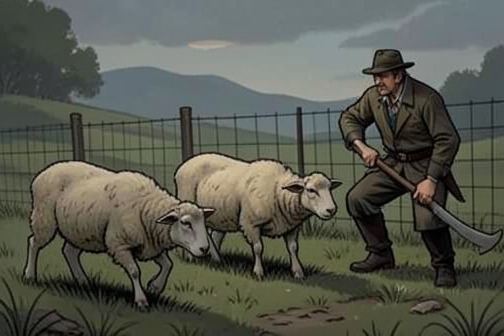
[The flock feigns scrapie to drive Gabriel away](entity:event-recall-event-5c85b30134a3) by turning a disease they know about into a convincing performance. The episode reverses the usual direction of herding: instead of being driven by human fear and force, the sheep recognize what frightens [Gabriel](entity:character-recall-character-gabriel-bc97a48fb87d) and use it to make him abandon the pasture. Their deception depends on attention, shared rehearsal, and the sight of sick-looking bodies moving through grass.
## A pasture without its former shepherd
[George Glenn](entity:character-recall-character-george-glenn-db173571c431)’s death leaves the flock in a changed landscape. He had been found beside the [hay barn](entity:location-recall-location-hay-barn-4478115ff603), and the sheep had to face a world without their shepherd or a sheepdog. Gabriel’s arrival brings a different kind of human presence. He tends his own sheep in an enclosure separated from the flock by wire netting, while his actions on the pasture make clear that he is not simply taking George Glenn’s place.
One decisive image is Gabriel using George Glenn’s scythe. George Glenn had said that people who kept sheep could spare themselves such a tool; Gabriel nevertheless cuts grass at the foot of the hill, on the side facing away from the sea. To the sheep, the scythe becomes a huge iron claw, cutting down grass that Gabriel himself does not want to eat. They see destruction where he sees a task. The enclosure and the cut grass establish the material pressure around the later trick: the sheep are watching a human reshape their pasture and keep another flock behind wire.
## Recognizing what frightens Gabriel
The plan begins when [Melmoth](entity:character-recall-character-melmoth-40a40f9a8507) challenges the flock to pay attention to what Gabriel fears. [Miss Maple](entity:character-recall-character-miss-maple-a9c5dcdeac95) identifies fences: human beings put them up when they are afraid. The sheep look toward Gabriel’s enclosed flock, whose members are staring hungrily through the wire. That glance connects the insight to the visible barrier already dividing the animals. The flock does not need to overpower Gabriel physically; it needs to make him respond to the danger he believes he sees.
Melmoth then proposes a more unsettling possibility: what if the flock itself falls ill? [Zora](entity:character-recall-character-zora-86e14b4c614c) objects that Gabriel’s sheep already have a hard enough time and that she does not want them to become ill. Mopple worries that disease could pass to his flock. Their discussion keeps actual illness and its consequences in view even as the scheme turns toward imitation.
[Cordelia](entity:character-recall-character-cordelia-16682bee45d5) supplies the vocabulary that makes the performance imaginable. Names she learned from George Glenn surge through her thoughts: prophylactics, foot rot, meningitis, and Creutzfeld-Jakob, among other terms from a book about sheep diseases. The remembered words are not merely labels. They give the flock a repertoire of feared conditions and help transform an idea into a plan. A short time later, the sheep have decided what to do.
## Rehearsing an illness
The flock withdraws into the hay barn to practise. When the sheep emerge into daylight after a considerable interval, they are themselves bemused by the terror they had conjured in the dimness. The episode makes rehearsal part of the action: their illness is not a spontaneous accident but a collective performance, prepared out of sight before being presented to Gabriel.
The chosen appearance is scrapie. As Gabriel works with his scythe, one Blackface sheep stumbles and falls. It struggles to its feet, takes a few steps, and falls again; another sheep stumbles behind it. A fat ram rubs his head against the wall of the hay barn as if possessed. These separate gestures accumulate into a pattern that Gabriel recognizes as disease. The flock’s acting is comic in its deliberate artificiality, but its effectiveness depends on a real vulnerability: scrapie is frightening precisely because the symptoms seem to announce a danger the flock cannot control.
## Gabriel abandons the enclosure
Gabriel’s reaction confirms that the disguise has worked. He cries out that it is scrapie. The sheep continue reeling and picking their way through the grass with shaky, unnaturally high steps, even after he has stopped watching them; now they are enjoying the performance. Their amusement sits beside the seriousness of the consequence: Gabriel immediately whistles for his dogs and tears a gap in the wire fence he had taken such trouble to build.
The dogs then drive Gabriel’s sheep out of the enclosure in orderly fashion, without panicking them. This is a sharp contrast with the flock’s deliberately disordered movements. The dogs demonstrate the controlled herding Gabriel can command, while the sheep’s deception has already prompted him to dismantle the barrier and remove his own flock. A few minutes later, dust on the field path and the empty fenced enclosure are the remaining signs of [Gabriel and his sheep](entity:relation-recall-relation-gabriel-and-his-shee-e3148ecf2074). [Heather](entity:character-recall-character-heather-c102c98231de) is pleased to think they will not return; Miss Maple expects to see Gabriel again at noon, under the old lime tree, when the shadows are short. The trick wins the immediate contest, but the flock’s expectation of a further meeting leaves its consequence open.
## Reversal through attention and performance
The episode turns knowledge into action without giving the sheep human tools or human authority. They observe a fear, connect it to the wire fence, recall the language of disease, and use their bodies to make an imagined illness persuasive. Gabriel’s response completes the reversal: he is the one who breaks the fence and moves his sheep away, while the flock that performed sickness remains on the pasture.
That reversal belongs to a broader contest over land and care. George Glenn’s garden behind the caravan had been fenced against the sheep, and Gabriel’s wire enclosure likewise separates hungry animals from grass and pasture. The sheep’s tactic does not settle the larger conflict by force; it exploits the human impulse to contain and protect by making containment seem unsafe. Their triumph is therefore both strategic and theatrical. They do not become ill, but for a time they make the pasture look as though illness has taken command.
Event 21
Reading George’s will and the flock’s selection of Rebecca as shepherd
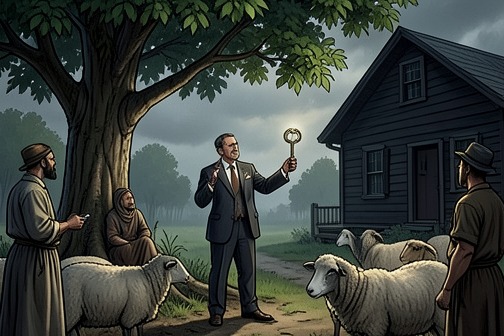
The reading of [George Glenn](entity:character-recall-character-george-glenn-db173571c431)’s will and the flock’s selection of [Rebecca Flock](entity:character-recall-character-rebecca-flock-3ba79c2ff67c) transform an inheritance into a test of whether sheep can make their own wishes count within a human legal process. [George](entity:character-recall-character-george-4ccc9776b2d0)’s will gives his flock the means to go to [Europe](entity:location-recall-location-europe-90be8cc79c46), as he had promised, but the journey depends on a human representative. The lawyer can arrange the appointment; only the flock can make clear whom it wants. The public ceremony thus joins legal authority to animal choice, with the sheep’s actions supplying the answer the humans cannot initially hear.
## The public reading
George Glenn’s will was dated April 30, 1999, and directed that it be read publicly at noon beneath [Glennkill](entity:location-recall-location-glennkill-d43fed88eba6)’s old village lime tree on the Sunday after his death, or the Sunday after that. At the reading, the lawyer looked out over villagers gathered to learn what would happen to George’s property. The heat, the silence, and the lawyer’s deliberate pacing gave the proceedings the charged feel of an approaching storm. For the sheep, there was a further source of suspense: George himself had written the document, and they were hearing something read aloud to them for the first time in a long while.
The first bequest described in detail went to [Kate](entity:character-recall-character-kate-ba739b4bb276). George left her his library, a collection that included seventy-three trashy novels, one detective story, a book of Irish fairy tales, and a book on sheep diseases, as well as everything else the law considered her due. The lawyer also told her she could keep the house and would receive a small annuity. Kate nodded with her teeth clenched. The list made the will’s personal texture audible: alongside formal provisions, it preserved a portrait of George’s reading and the particular contents of his shelves.
The next bequest startled the crowd by naming Rebecca Flock as George’s daughter. Whispers rose as villagers tried to make sense of the revelation. The reading therefore unsettled more than expectations about the estate: it publicly identified a relationship that had not been understood by those listening. The lawyer continued through the document before announcing that the remaining fortune, a sum far beyond the sheep’s frame of reference, went to the flock so it could travel to Europe as George had promised.
## The conditions of the inheritance
The legacy was not simply a payment to the sheep. The lawyer would administer the money, and the animals needed an authorized representative to accompany them as shepherd. George’s will set out that representative’s rights and duties, making the practical future of the flock depend on a human appointment. The lawyer was meant to use his own judgment in choosing someone, preferably at once, and he distributed printed sheets explaining the conditions.
Those conditions placed the flock’s treatment at the center of the representative’s work. The sheep were to have stories read aloud to them for at least half an hour each day. None could be sold or slaughtered, and dense fleece was to be the chief concern in breeding. The lawyer would check that the terms were observed as a third party. In answer to the villagers’ objections that these were not economically minded provisions, he explained that the representative would receive a substantial salary. It would fall by a specified amount whenever a sheep died; if all the sheep died, a small final premium would be paid and further payments would stop. Care was therefore both a legal obligation and the basis of the representative’s compensation.
The villagers’ attention sharpened when the terms and salary became clear, but no one immediately challenged [Gabriel O’Rourke](entity:character-recall-character-gabriel-o-rourke-242554eb30be) after he stepped forward and volunteered. The flock read the human silence differently: it resembled the deference shown when a lead ram had already taken something on. The decision might have stayed with [Gabriel](entity:character-recall-character-gabriel-bc97a48fb87d) by default, but the lawyer asked whether anyone else wanted the position. In that pause, the possibility of another choice opened.
## How the flock makes its choice
Rebecca Flock offered herself for the job. The lawyer arranged the decision by placing her and Gabriel apart before the flock and asking whom it wanted to accompany it to Europe as shepherd. At first the sheep’s answer failed to register as an answer. [Maude](entity:character-recall-character-maude-a64555802aa1) bleated [Rebecca](entity:character-recall-character-rebecca-a2bff63b7d1a)’s name; [Lane](entity:character-recall-character-lane-aadcfcb57a55), [Cordelia](entity:character-recall-character-cordelia-16682bee45d5), and Mopple joined in, but the lawyer did not understand them, and the flock fell silent, uncertain how to communicate its preference through the procedure.
Gabriel’s manner offered a competing form of persuasion. He murmured in Gaelic, a soft, melodic performance that had once been able to enchant the sheep and still carried a certain charm. [Othello](entity:character-recall-character-othello-45ef6b29852c) moved first. He stepped forward, looked briefly at Gabriel, then turned and trotted to Rebecca. The rest of the flock followed him and clustered around her. Their decision was no longer a few isolated bleats that a human could dismiss as noise: their movement made the choice visible, and the sheep repeated Rebecca’s name together.
The lawyer accepted the result as a unanimous vote, closed his briefcase, and wished George Glenn’s sheep well in Europe. The resolution depended on an improvised translation between species. The lawyer supplied the question and recognized the outcome; the flock supplied its answer through voice and collective movement. Gabriel’s fluency with sheep and his willingness to take the job did not outweigh the choice the sheep themselves enacted.
## Consequences and significance
The appointment settled who would represent the flock on its journey, while the inheritance gave that journey material backing and binding protections. The sheep returned silently to their meadow. They had not understood every detail of the will, but they understood that Europe awaited them as a vast meadow full of apple trees. [Zora](entity:character-recall-character-zora-86e14b4c614c), still dazed by the announcement, put their immediate sense of the outcome into words: they were going to Europe.
The event also brings together two forms of promise. George’s written will makes his promise of Europe enforceable through money and specified duties; the flock’s vote determines which human will accompany it. The legal document protects the animals from sale and slaughter and requires daily reading, yet its procedures initially fail to recognize their speech. Only when Othello leads the flock toward Rebecca does their preference become legible to the assembled humans. The scene’s turning point is therefore not merely that Rebecca volunteers, but that the sheep make her selection their own—and that the lawyer accepts their collective action as a decision.
Event 22
Rebecca discovers and hands over George’s smuggling cache
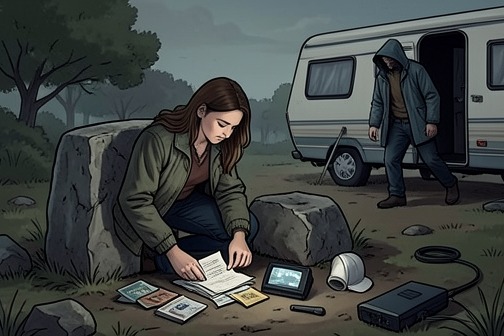
[Rebecca discovers and hands over George’s smuggling cache](entity:event-recall-event-rebecca-george-96b39a8f15e9) in an episode that converts a half-understood human secret into material evidence, then puts that evidence—and her own safety—at risk. A key on a string leads her to packets buried beneath the dolmen; there she finds not only the contraband but also a file and a videotape. When a man arrives at [George](entity:character-recall-character-george-4ccc9776b2d0)’s caravan, his account confirms that George worked for a smuggling firm, while his denial about the murder leaves the central killing unresolved.
## The cache beneath the dolmen
The discovery follows the loss of George and the flock’s uncertain adjustment to life without their shepherd. His body had been found beside the [hay barn](entity:location-recall-location-hay-barn-4478115ff603), with a spade projecting from it; elsewhere, people’s talk had already suggested that the attractive pasture and its isolation concealed a more profitable use. In particular, local speculation linked George to nighttime boats bringing goods ashore, their transfer to his caravan, and his departure in an old car the next day. That account was suspicion, not proof. The cache makes the suspected trade tangible without answering who killed him.
The immediate path to it is small and accidental. [Rebecca](entity:character-recall-character-rebecca-a2bff63b7d1a) comes out of George’s caravan after hearing a lamb cry. On the steps she notices a key hanging from a string, picks it up, and follows the sound beneath the dolmen. The flock has prepared the ground: [Othello](entity:character-recall-character-othello-45ef6b29852c) has scraped away earth so the hidden box will be easier for her to find. Rebecca laughs when she uses the key, as though the discovery has turned a neglected object into the answer to a puzzle.
Inside, she takes out a small packet and bites through its string. Plastic crackles, and something dry crumbles in her fingers. She recognizes the material as grass; the flock, smelling it too, understands at once that it can be eaten. The packets recall journeys George had made with his sheep to another pasture, when he called the trips [Operation Polyphemus](entity:action-recall-action-operation-polyphemus-057f707bf8c1). Each sheep had carried one of these small, string-tied packets beneath its belly and deep in its fleece, unaware of what it contained. What had seemed like an unexplained routine now reads as a means of transporting contraband with the flock.
Rebecca does not stop at the first packet. Holding her skirt out like a bag, she gathers all she can find beneath the dolmen: many small packages, a larger rectangular one, and a file of papers. She carries the overloaded bundle back to the caravan and remains out of sight for a time. The contents are not all alike. The packets are the drug the humans have called grass; the file holds information important enough that its eventual visitor describes it as a threat to his firm; the rectangular package proves to be a videocassette, though he says he has never heard of it.
## Rebecca’s account and the personal cost
Before the visitor arrives, Rebecca reads aloud and then puts the book aside. She tells a story about a girl with two fathers, one publicly acknowledged and one secret. The girl and her secret father are fond of one another, but after a quarrel they stop speaking. When he writes that he plans to travel to [Europe](entity:location-recall-location-europe-90be8cc79c46) and wants to see her first, she hides her happiness and keeps him waiting; he dies before they meet. The story makes Rebecca’s relation to George legible as more than a matter of inheritance or investigation: George was her secret father, and their estrangement had left a final meeting unrealized.
The telling is surrounded by the recovered contraband. Sweet, heavy smoke drifts over the meadow after Rebecca returns to the caravan with the cache, and the sheep grow sleepy. Mopple, however, has been intent on tasting the packets ever since their contents were identified. While Rebecca sits outside in the dark, he finds an open one and swallows its contents before she notices. By the time she sees him, he is licking the last crumbs from the caravan steps. His impulsive theft later matters to the count: the visitor finds twenty-three packets, one fewer than the cache had originally contained, and calls the missing portion sheep feed.
The sequence sets two forms of appetite beside each other without making them equivalent. The flock recognizes edible grass through smell and taste; the humans have made that same material part of a commercial operation, concealed in the wool of animals who do not know they are carrying it. Rebecca’s discovery gives her the facts, but not a simple resolution. Her story of the absent father places grief and delayed understanding beside the practical danger of the cache, while the sheep’s accidental consumption leaves a physical trace in the visitor’s accounting.
## [The firm](entity:organization-recall-organization-the-firm-b6724c8f5843)’s representative
At night, a powerful car approaches the meadow without lights. A man gets out, crosses to George’s caravan, pauses to sniff the air, and knocks several times. His arrival makes the buried cache more than an archive: someone connected to its former use has come to retrieve what remains. The scene is observed by the flock, whose attention to scent and movement registers the tension around the caravan even when it cannot know everything being said inside.
The man identifies George as one of the firm’s best operatives, a specialist on consignments between [Ireland](entity:location-recall-location-ireland-3247a2c8bcbe) and Northern Ireland, and describes his record as having been free of incidents. Rebecca asks whether the operation was really all for grass. The man says it was mainly grass, but that cigarettes and other goods were also carried when the market demanded them. The answer confirms that the cache belongs to a broader, adaptable trade rather than a single shipment. His description also gives a sharper meaning to the earlier suspicion about boats, the caravan, and George’s old car: the pasture’s apparent isolation was compatible with an organized route for moving goods.
The file changes the balance of the encounter. The man points out that Rebecca has it and says its information could deal the firm a severe blow. She tells him she will do nothing with it; he says he believes her, but insists that belief is not enough. His apology, followed by the caravan’s light going out, marks the exchange as threatening without making the threat’s exact form explicit in the flock’s account. The sheep sense a heavy, oppressive, violent disturbance inside. The event therefore does not reduce the handover to a straightforward recovery: Rebecca possesses leverage, the visitor has power, and the consequences of the documents remain unsettled.
## Handover and unresolved consequences
The visitor eventually denies that his firm had anything to do with [George’s death](entity:action-recall-action-4384f06c6fc4). He says that no one in his line was responsible and contrasts the killing’s theatrical, almost ritual quality with the firm’s methods, which he says do not depend on that kind of intimidation. His statement narrows one possibility but does not identify the murderer. The killing of George remains an open question, and the man’s assurance is still the claim of an interested representative rather than a solution established by the scene.
He counts the packets as he removes them from the makeshift bag in Rebecca’s skirt: twenty-three, with one packet of sheep feed missing. He takes the file as well. When he notices the rectangular package, Rebecca identifies it as a videocassette; he says he has never heard of it and pockets it too. The count makes Mopple’s earlier theft part of the evidence’s physical history, while the cassette introduces information the firm apparently did not expect to find among the goods. The scene does not disclose what the recording contains, so its significance remains a possibility rather than a revealed answer.
Before leaving, the man carefully lifts Rebecca’s hand and kisses her fingertips without speaking. He returns to his car and drives away without saying goodbye. The gesture gives the transaction a personal, uneasy close, but it does not undo the imbalance or settle what the man’s apology meant. Only when the engine can no longer be heard does the flock relax. For a moment, the caravan again holds George’s daughter; [Gabriel](entity:character-recall-character-gabriel-bc97a48fb87d) and his voracious sheep have disappeared, and Europe seems within reach. That sense of restored order is brief: the night continues to bring people into the meadow.
The episode’s pastoral setting is therefore also a working landscape, a hiding place, and a route through which goods have passed. The green pasture, the sheep’s wool, and the small packets belong to the same chain of events, though the flock initially knows only the first two as parts of its world. By letting Rebecca uncover the evidence while the sheep interpret it through smell, appetite, and remembered journeys, the scene reveals the trade without making the animals understand its full human machinery. It also separates two questions that had seemed joined: George’s smuggling work is confirmed, but the identity and motive of his killer remain unknown.
Event 23
George Glenn’s suicide and Beth’s assistance
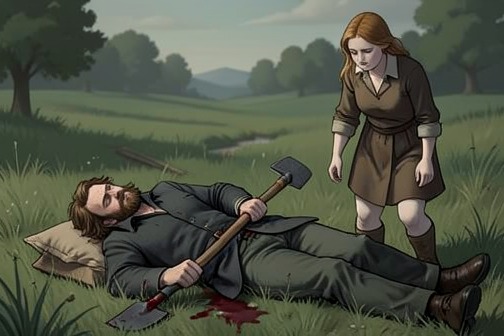
[George Glenn’s suicide and Beth’s assistance](entity:event-recall-event-george-glenn-beth-8a4a6c9f74b3) emerge as the answer to the flock’s murder investigation, but the revelation is also a painful account of a final failed farewell. [George](entity:character-recall-character-george-4ccc9776b2d0) came to [Beth](entity:character-recall-character-beth-c520a0bef2d7) because he had decided he could not continue toward the life he had imagined in [Europe](entity:location-recall-location-europe-90be8cc79c46); she begged him not to die, yet could not change his mind. His insistence that a spade be involved, and Beth’s arrival in the meadow after he was already dead, explain why his death appeared to be a murder. The confession resolves the mystery while exposing how little the flock had understood of George’s loneliness and despair.
## The Final Visit
Beth places the decisive encounter on the Sunday before last, late in the evening. George knocked at her door while she was still awake. As in their previous meetings, she began talking about the Gospel; this time he gently stopped her and told her the matter was important. Beth had imagined a different kind of intimate moment with him, but George had come to say goodbye. When she assumed he meant that he was leaving for Europe, he corrected her. She understood that he meant something more final, though the account does not specify every word that passed between them afterward.
George explained why he had come, and Beth repeatedly begged him not to do it. He had once looked forward to Europe and, in some sense, still wanted to go. But he was afraid and believed it was too late. The contrast matters: the promised journey had not become meaningless to him; rather, facing it had become unbearable. Beth could not supply the courage he lacked. Her account presents the decision through the limits of what she could do and say, not as a sudden, fully explained turn of events.
## Beth’s Part in the Death
Beth acknowledges that she even helped George do things the way he wanted. She connects that assistance to her fear that, otherwise, he would not be buried. The confession is explicit about her involvement but does not set out its practical details, so it does not establish precisely what she did. She says she would have gone with George, but he did not want her to. He told her that in an hour he would have it over with; Beth went to the meadow in pouring rain and found him already dead.
That sequence separates Beth’s helplessness from the final act without making her a detached witness. She had pleaded with George, could not persuade him, and then followed the course he had asked of her. Her recollection gives the waiting and the rain particular weight: by the time she reached him, the decision she had tried to prevent had already become irreversible. She describes the aftermath as wrong and sinful, yet cannot make that judgment cancel her sense that she had acted for him. Her tears and the brief, fragile smile that appears as she remembers him register grief that has not been settled into a simple explanation.
## The [Spade](entity:object-recall-object-spade-a8d61ec9f55c) and the Appearance of Murder
When [Ham](entity:character-recall-character-ham-d7883aa636d4) quietly asks why [George’s death](entity:action-recall-action-4384f06c6fc4) involved the spade, Beth says she does not know why George insisted on it. She remembers that he wanted it to give people something to think about and that she could not persuade him otherwise. The detail makes the appearance of murder part of George’s own plan, but it does not explain his full purpose or describe exactly how the spade was used. Beth calls the decision terrible; her answer offers no neat distinction between the truth of his death and the misleading impression he left behind.
Ham’s reply shifts the question from the object to the person: the issue, he says, is not the spade but George. Beth responds by defending the depth of George’s fear and loneliness. She recalls an earlier moment involving a handkerchief: she had placed it in his hand without speaking, and he had looked at her without understanding. Only later did she recognize her silence as the great mistake of her life. In her account, that earlier failure and the final visit are linked by the same painful inability to say or do what might have changed the course of their relationship. She does not claim that one moment explains the other; instead, the handkerchief becomes the measure of a hope she could barely bear and a fear that proved stronger.
## Revelation and Consequences
Beth sees George as having moved away from everything, step by step, alone with his sheep. She had noticed that isolation even though, as she says, he laughed at her. Her testimony therefore changes the flock’s understanding not only of how George died but of the life it had watched from the pasture. What they had treated as a murder to be solved was also a death shaped by a despair they had not recognized in time.
The flock reaches the conclusion through questions and competing judgments. [Zora](entity:character-recall-character-zora-86e14b4c614c) asks whether George murdered himself; [Fosco](entity:character-recall-character-fosco-bf8300f8cf08) confirms the idea and names it suicide. Mopple initially insists that Beth is lying and refusing to admit that she killed George, but the flock reads her scent as evidence that she is telling the truth. This contrast shows how the sheep’s investigation depends on ways of knowing different from human legal or verbal proof, even as the meaning of the event must be learned through Beth’s account. [Suicide](entity:concept-recall-concept-suicide-4b0a539f274a) is a new word for them, one George can no longer explain. Fosco supplies a general human meaning: some people look at the world and decide they do not want to live. The murder mystery thus ends not with a hidden attacker exposed, but with the flock confronting a human choice it had not previously understood.
Event 24
The flock’s murder reenactment at the Smartest Sheep in Glennkill contest
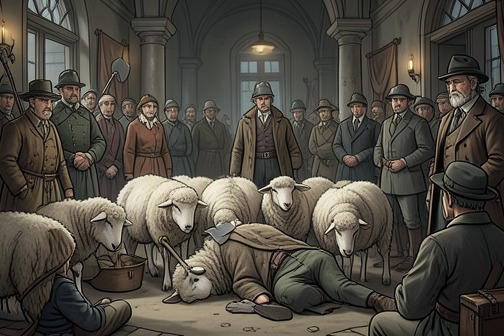
[The flock’s murder reenactment at the Smartest Sheep in Glennkill contest](entity:event-recall-event-glennkill-81bd4cee3461) transforms a sheep competition into a public inquiry: [Miss Maple](entity:character-recall-character-miss-maple-a9c5dcdeac95), [Zora](entity:character-recall-character-zora-86e14b4c614c), [Othello](entity:character-recall-character-othello-45ef6b29852c), and [Mopple the Whale](entity:character-recall-character-mopple-the-whale-c8870eb308f4) reconstruct [George Glenn](entity:character-recall-character-george-glenn-db173571c431)’s death until [Beth](entity:character-recall-character-beth-c520a0bef2d7)’s own account reveals that he chose to die and she helped conceal his suicide. The performance first has to teach its human audience how to read it. Its decisive effect is not merely to imitate a crime, but to make a concealed history visible—and to bring [Inspector Holmes](entity:character-recall-character-inspector-holmes-a9f397fe1c2a), who had been unable to solve the case, to its truth.
## A contest becomes an investigation
Inspector Holmes arrives at the contest already frustrated. His Guinness is a duty rather than a pleasure, and the festive gathering of tourists and local people only sharpens his sense of being out of place. He recalls how he had suspected [George](entity:character-recall-character-george-4ccc9776b2d0)’s family but found that the red-haired woman had an alibi; faced with the legacies and no clear solution, he had even considered arresting the heirs simply to have an arrest to make. The sheep’s act will overturn that inadequate certainty in public.
The contest’s other performances establish a disquieting contrast. [Sheep](entity:creature-recall-creature-sheep-fc2e92cc9afd) run in circles at a shepherd’s whistle, leap over obstacles, and respond to signals; one frightened, unnamed brown ewe freezes until her shepherd strikes her with a stick, then races across the platform and falls. The performance receives some applause. Against this spectacle of animals being directed for human approval, George Glenn’s flock comes onstage with a purpose of its own: to get justice out. The stage is still a human-made arena, but the sheep have chosen what it will show.
The bespectacled presenter introduces them under incorrect names. Zora objects, and Othello rejects the suggestion that he looks like a donkey. Miss Maple nevertheless gives the flock its cue: they should follow the plan and remember what [Melmoth](entity:character-recall-character-melmoth-40a40f9a8507) taught them. Their entrance into the dazzling light begins an act whose meaning depends on the sheep controlling their own movements, rather than simply performing obedience.
## Reconstructing the death
Zora begins by lying on her side and stiffening her legs to represent George’s position at death. The first attempt wins scattered applause, but Miss Maple sees that the audience has not understood. Zora tries again more dramatically. The difficulty is not only to reproduce a death, but to communicate its sequence and cause to viewers who do not share the flock’s knowledge.
The reenactment then moves back to George’s ordinary movements across the meadow. Zora takes long, straight steps to represent him, while Miss Maple plays Beth. In the scene, George leaves the steps of the shepherd’s caravan to visit her. Beth greets him, indicates that she wants him to do something, and meets his impatient refusal. She then offers refreshment. Zora dips her nose into an imaginary puddle and drinks; the flock’s earlier alarm at this moment has been too late to stop the represented George from drinking poisoned water. Zora falls again, making the poisoning legible through action rather than explanation.
The sheep give the aftermath its own stage picture. Othello appears as death, a black ram watching over the body alongside Beth. Miss Maple moves Zora back toward the meadow, though the image cannot be made entirely convincing: Zora has to help by pushing with her powerful legs. In the finale, Zora lies rigid on her back, and Miss Maple stamps on her chest with a forehoof in place of the unavailable spade. The flock has rehearsed this effect despite the bruises it caused Zora. Othello remains prowling beside the body as the performance carries [George’s death](entity:action-recall-action-4384f06c6fc4) from poisoning to the act with the spade.
## Scent, cloth, and recognition
To identify the murderer, the flock relies on scent, a form of evidence it understands but doubts humans can appreciate. Mopple the Whale shakes a rag whose sharp smell the sheep have prepared to resemble Beth’s. [Maude](entity:character-recall-character-maude-a64555802aa1) found a faint, sourish trace in the toolshed; the flock strengthened it by burying the rag in dirt, covering it with chewed sorrel, and wrapping it around a recently dead shrew found by [Heather](entity:character-recall-character-heather-c102c98231de). [Sir Ritchfield](entity:character-recall-character-sir-ritchfield-b2c8606df44b) took on the task of chewing the sorrel. The resulting smell is not identical to Beth, but the sheep consider the likeness clear enough to guide a human audience with a poorer sense of smell.
The scent is paired with a visible object: a chain with a glittering pendant, like Beth’s. The flock tried to hang it around Miss Maple’s neck, but it disappeared into her thick fleece, so she carries it in her teeth and presents the little cross to the audience while Mopple follows with the rag. This is an improvised translation between kinds of knowledge: scent, compelling to sheep, is given a human counterpart in the chain and cross. Something stirs in the hall; a curse is murmured, glass falls, and the butcher wheels himself up the ramp. The response does not yet amount to a spoken explanation, but the clues have broken through the audience’s passivity.
Mopple briefly leaves the stage for a piece of cake, then returns when the performance reaches its most difficult part. The flock must make Beth’s connection to George intelligible, not simply stage the physical sequence of his death. Its use of the rag and pendant has brought the audience to the threshold of recognition, but the decisive account will come from Beth herself.
## Beth’s account and Holmes’s realization
After the sheep’s act, Beth walks down the central aisle holding the rag. She has unfolded it, and the flock can see the pattern of two red signs on a white background. She approaches the stage calmly and sits on its edge rather than joining the presenter on the platform. Holding and carefully smoothing the cloth, she begins by speaking about herself, then connects it to George and to a mistake she had long regretted: she had once put a handkerchief in his hand without saying what she meant, and afterward could neither speak nor act. Seeing the cloth again has made her recognize the importance of that failure.
Beth recounts that George came to her late one evening on the Sunday before last. As on earlier visits, she began speaking about the Gospel. This time he gently stopped her and said the matter was important. She had imagined a different reason for such an approach, but George had something else in mind. Beth says she could not give him the courage to go on and then helped him do it as he wanted, believing that otherwise they would not bury him. He told her that in an hour he would have it over with in the meadow. She went there in the pouring rain and found him already dead. Her account makes clear that the sheep’s staging of poisoning and death by a spade had represented a concealment, not the truth of George’s chosen end.
Inspector Holmes watches the case solve itself onstage. He understands that George died by suicide and that the business with the spade was Beth’s doing. His earlier suspicion of the family and his readiness to arrest the heirs had mistaken a visible murder story for the explanation. The sheep’s demonstration supplies the image that unsettles that interpretation; Beth’s testimony supplies its human meaning. Holmes still recognizes that the lonely man’s reasons cannot be fully understood, but the central fact of the case is no longer obscure.
## What the performance changes
The event shifts the flock’s work from private investigation to public disclosure. At first, the humans see a contest act and respond unevenly: Zora’s initial death scene is not understood, the sheep receive only halfhearted applause, and the clues provoke gestures before anyone explains them. Yet the performance’s sequence—George’s visit, the poisoned drink, the body, the scent, and the pendant—creates a structure that Beth can enter and complete with her own testimony.
Its method also preserves a difference between human and sheep knowledge rather than erasing it. The flock makes scent tangible through the rag, translates the pendant into a stage prop, and substitutes Miss Maple’s hoof for a spade. These approximations are sometimes awkward, but their awkwardness exposes the work of communicating across species. The sheep are not simply objects in the contest: they organize the reconstruction, interpret the clues, and direct attention toward a truth that the human investigator had missed. By the time Beth speaks and Holmes understands, the stage has become both evidence and witness.